

A Customer Asked: “Why Is My Sump Pump Running Every Few Minutes in My Alcona Home?” What We Usually Find
Last updated: August 7, 2026
Published August 7, 2026 · Updated August 7, 2026
A sump pump that restarts every few minutes on a dry week is almost never a pump that’s “too weak” – the pump is usually pumping the same water over and over because the check valve failed or the discharge line is frozen, blocked or draining back into the pit. Nine times out of ten we find one of four things: a bad or missing check valve, a float switch hung up on the pit wall or the pump cord, groundwater sitting high after spring melt, or a discharge that dumps too close to the foundation and loops right back in. The fix is usually a part, not a whole new system.
- Short-cycling every 1 to 5 minutes with no rain points to backflow – the water in the vertical discharge pipe falling back into the pit when the pump shuts off. That is a check valve problem.
- Alcona and Lefroy sit close to Lake Simcoe with a high water table in newer subdivisions. Continuous light running in April and November can be normal groundwater, not a fault.
- A pump that runs nonstop and never empties the pit is either airlocked, has a clogged impeller, or the discharge line is frozen at the exterior outlet – a very common winter call in Stroud, Painswick and Midhurst.
- Typical sump pump service and diagnosis in Simcoe County runs in the range of $140 to $260 for a service call and check valve replacement; a full 1/3 or 1/2 HP cast-iron pump swap typically lands in the $550 to $1,100 range installed. Those are category norms, not our quoted price – we give you the number before we start.
- Do not ignore it. A pump cycling 300 times a day burns out a motor in months, and it usually fails on the wettest night of the year.
The Short Answer: Why a Sump Pump Running Constantly in an Alcona Innisfil Basement Is Usually a Check Valve
A sump pump running constantly in an Alcona Innisfil basement, cycling every two or three minutes on a dry week, is most often pumping the same few liters of water in a loop. When the pump shuts off, everything sitting in the vertical discharge pipe above it drains straight back down into the pit. The float rises again. The pump kicks on again. Repeat, all night, until the motor cooks.
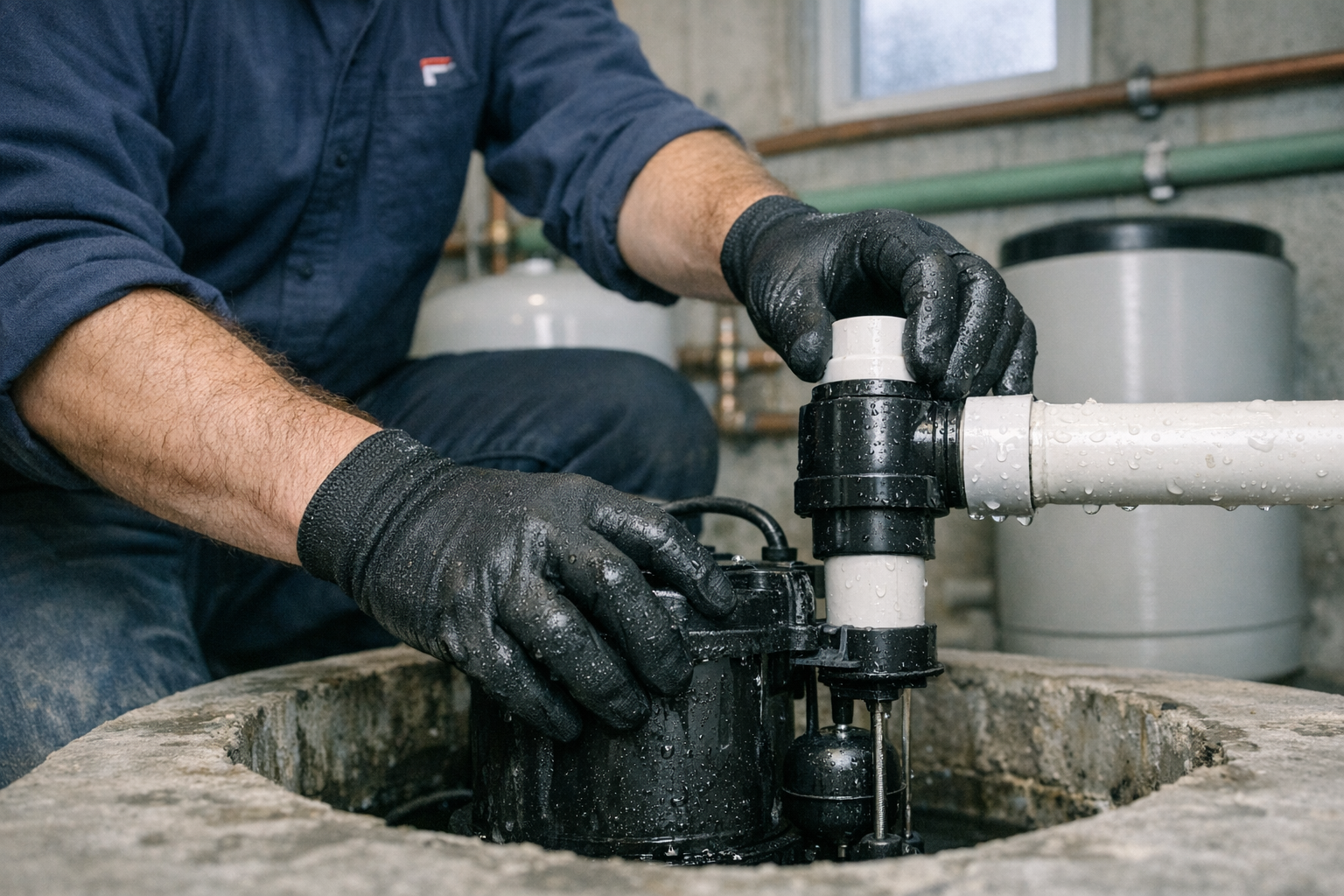
The part that stops that is a check valve – a one-way flapper on the discharge line just above the pump. They wear out. The rubber flap gets stiff, or a stone gets caught under it, or the previous installer never fitted one at all. This is a straightforward repair, and it is the first thing we check when we pull the lid off a pit in Alcona, Lefroy or Stroud.
If you’re a homeowner in one of the newer Alcona subdivisions off the 20th Sideroad or down toward the lake, and your pit has been busy since the snow went – the second cause on our list matters more than the first. Read the groundwater section below before you buy a pump.
The Full Answer: What We Actually Find When We Open the Pit
Here’s the honest version of how this call goes. We arrive, we ask you to stop the pump at the breaker or unplug it, and we watch the water level in the pit for sixty seconds. What the water does in that minute tells us almost everything.
1. The Check Valve Has Failed (Or Was Never There)
A failed check valve is the single most common cause of a sump pump short-cycling in Simcoe County homes. You can hear it yourself: after the pump shuts off, listen for a gurgle and a splash back into the pit within a couple of seconds. That’s the column of water in the pipe coming home.
On a basement with a tall discharge run – and most Alcona and Bradford basements have a full-height run before the pipe exits the wall – that backflow can be several liters. Enough to re-trip the float on its own. The pump never gets a rest.
Check valves are consumables. The spring-loaded and flapper styles both stiffen with age and iron scale, and in rural Innisfil and Cookstown homes on well water, iron-rich water builds an orange crust on the flap that stops it seating. Plan on inspecting yours whenever you service the pump.
2. The Float Switch Is Hung Up, Set Too Low, or Fighting the Pit Wall
The second thing we look at is the float. Tethered floats need room to swing. Drop that pump into a narrow pit, or let the power cord coil around the float arm, and the switch starts making contact way too early – sometimes with only an inch or two of water above the pump.
We also find floats sitting against the pit sidewall in older Barrie and Orillia homes where the pit is a narrow crock rather than a modern basin. The float rides the wall, sticks, releases, sticks again. From upstairs it sounds like the pump has developed a nervous tic.
“Before anyone buys a new pump, we make them unplug the old one and just watch the pit for a minute. If the water level jumps the second the motor stops, it’s a check valve. If it creeps up slowly and steadily on a dry week, that’s groundwater and a bigger pump won’t fix your problem – it’ll just run harder.” – Matthew Allain
3. The Water Table Is Genuinely High – Which Is Normal Here in Spring and Late Fall
This is the part national plumbing content gets wrong for our region. Alcona, Lefroy and the shoreline stretch of Innisfil sit low and close to Lake Simcoe, and the newer subdivisions were built on ground that holds water. During the April melt and again during a wet October, a pump cycling every eight to fifteen minutes for days on end can be completely healthy behavior.
The distinguishing detail is rhythm. Groundwater infiltration produces a slow, steady, predictable rise. Backflow produces a fast re-trip within seconds of shutoff. Two very different sounds through the floor at 2 a.m.
If it really is groundwater, the conversation shifts from repair to resilience: a battery backup pump, or in some homes a second pump on a higher float as a redundancy. Because a healthy pump that runs 400 cycles a day in April still has a finite motor.
Fast re-trip within seconds of shutoff means backflow and a failed check valve. Slow steady rise on a dry week means a high water table, which is normal for Alcona and Lefroy in April and October. Continuous running that never empties the pit means airlock, clogged impeller, or a frozen discharge line.
4. The Discharge Dumps Too Close to the House and the Water Comes Right Back
We see this constantly on properties where a landscaper reworked the grade or a downspout extension got shortened. The sump discharge terminates a couple of feet from the foundation wall, the water soaks into the same backfill it just came out of, and the pump spends its life recycling the same puddle.
On flat lots in Alcona and Bradford this is brutal, because there’s nowhere for the water to run. The principle is simple: get the discharge as far from the foundation as your lot and your municipality’s drainage rules allow, and make sure the grade slopes away from the house. Confirm the discharge termination requirements with the Town of Innisfil before you re-route anything – municipalities restrict where sump water may be discharged, and it must never go into a sanitary sewer.
5. Winter: The Discharge Line Is Frozen and the Pump Is Screaming Against a Plug of Ice
This is our January and February version of the same call, and it sounds different – a pump running continuously with a strained, high-pitched whine, water level in the pit barely moving. Outside, the exterior discharge outlet has iced over. Nothing is leaving the house.
Cold air. The smell of hot motor windings in a closed basement. That’s the one we drive to fastest, because a pump running dead-headed against ice will burn out and then you have water and no pump. Our frozen and burst pipe service covers the same seasonal failure mode, and a frozen discharge often shows up in the same week as a frozen supply line in an unheated crawlspace out in Cookstown or Angus.
Prevention: an exterior discharge that terminates with a downward slope, no low spot to hold standing water, and no long horizontal run sitting exposed on the north side of the house.
6. The Pit Is Full of Silt, or the Impeller Is Choked
Sump pits collect sediment. In rural Innisfil and Alliston properties with clay and fine sand in the weeping tile, a pit can silt up to the point that the pump inlet screen is partially buried. The motor runs and runs and moves very little water.
A choked impeller sounds fine but performs terribly. We pull the pump, flush the pit, clear the intake, and often that alone stops the constant running. It’s not glamorous work. It smells like a pond.
Diagnose It Yourself in Four Minutes Before You Call Anyone
You can narrow this down before we ever pull into the driveway. Do it in daylight, and keep your hands out of the pit while the pump is plugged in.
Lift the lid and look
Note where the water sits when the pump is idle. If it’s within a few inches of the pump’s on-point, the float is set too low or the pit is undersized.
Listen for the splash-back
Wait for a cycle to end. A gurgle and a rush of water returning into the pit within two or three seconds means the check valve isn’t holding.
Unplug it and time the refill
With the pump off, watch for two minutes. Fast jump equals backflow. Slow steady creep equals groundwater. No rise at all on a dry day and the pump is short-cycling on a phantom float signal.
Walk outside and find the outlet
Is water actually coming out when the pump runs? Is it discharging into a puddle right against the foundation? In winter, is the end iced shut? Plug the pump back in before you leave the basement.
Sound-and-Symptom Table: What Each Pattern Usually Means
| What you’re hearing | Most likely cause | Typical fix |
|---|---|---|
| On for 10 seconds, off, on again 90 seconds later, no rain | Failed or missing check valve, water draining back down | Check valve replacement, typically $140-$260 with a service call in Simcoe County |
| Erratic starts, sometimes runs, sometimes doesn’t | Float hung on cord or pit wall, or a failing switch | Reposition pump, secure the cord, or replace the switch |
| Steady cycles every 8-15 minutes for days in April | High water table, common near the Lake Simcoe shoreline | Usually normal; consider battery backup for redundancy |
| Runs continuously, pit level barely drops, motor sounds strained | Airlock, clogged impeller, silted pit, or frozen discharge | Pull and clean the pump, clear the line, thaw the exterior outlet |
| Loud hum, no water movement, hot smell | Seized or dead-headed motor | Pump replacement, typically $550-$1,100 installed for a cast-iron 1/3 to 1/2 HP unit |
Those dollar figures are category norms for our region, not a quote from us. We price the specific job in front of us and tell you the number before any work starts.
When the Answer Is Different
Not every constantly-running sump pump in Innisfil, Barrie or Bradford is a check valve. Here are the situations where our answer changes on site.
Your Home Is on a Septic System and the Pit Is Filling With Something It Shouldn’t Be
On rural properties around Cookstown, Angus, Alliston and the concession roads of Innisfil, we occasionally find a sump pit that’s filling because of a failing septic bed or a cross-connection, not groundwater. The tell is smell and color. If the water in your pit is gray, soapy or has an odor, stop and call – that is a health issue, not a pump issue.
Your Sump Pit Is Also Collecting a Water Softener or Well System Discharge
Plenty of homes on well water in Innisfil, Stroud and Midhurst have a water softener that discharges its regeneration brine into the sump pit. If your softener is regenerating too often – a stuck valve, a bad setting, a failing meter – your sump pump gets a surprise workload every night at 2 a.m.
Salt water is also hard on a pump. If your pit runs mostly at the same hour every couple of nights, look at the softener before you blame the pump. Our water softener and well system work and our sump work overlap on rural properties more than people expect.
Seasonal and Cottage Properties Around Lake Simcoe and Orillia
If you own a seasonal place near Lefroy, Big Bay Point or up toward Orillia and you’re only there weekends, a sump pump running constantly is the failure mode that costs the most. Nobody hears it. The motor burns out in March, the melt keeps coming, and you open the door in May to a flooded basement and ruined flooring.
This is one of the few places where we genuinely recommend a smart water monitor. A Moen Flo won’t watch your sump pit directly, but paired with a water alarm in the basement it means your phone tells you something is wrong instead of the drywall telling you in May. For an absentee owner, that alert is worth more than any pump upgrade.
The Pit Is Tied Into a Drain That’s Actually the Problem
In older Barrie, Painswick and Orillia homes, weeping tile connections and floor drains have been reconfigured over decades by various hands. Sometimes what looks like groundwater is a partially collapsed or root-blocked drain line pushing water into the pit.
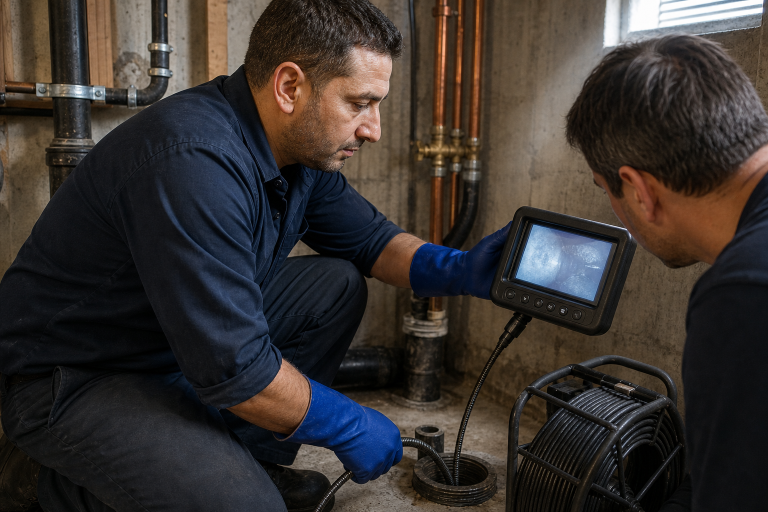
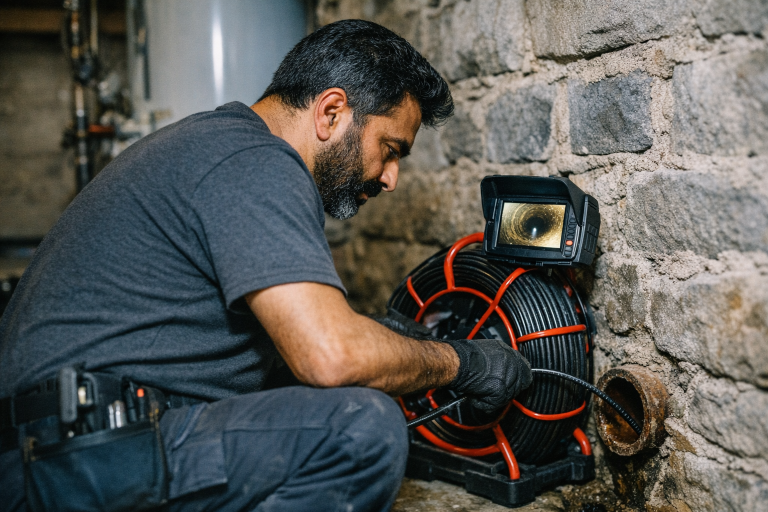
That’s when we run the camera. You watch the screen with us – that’s how we work, the camera goes in the line and the homeowner sees exactly what we see. A drain camera inspection settles the “is it the drain or the water table” argument in about fifteen minutes instead of after two failed pump replacements.
Three Mistakes We See Around Basement Water (Learn From Them Cheaply)
These aren’t hypotheticals. They’re the patterns that generate the callbacks we take month after month across Innisfil, Barrie and Bradford.
Mistake one: the DIY shutoff valve swap with no plan to isolate the main. We get two to three emergency calls a month from a half-finished DIY where the valve snapped off in someone’s hand and they couldn’t stop the flow. If you’re in the basement anyway working near the sump, know where your main shutoff is and know that it actually closes. Test it on a Saturday, not during an emergency.
Mistake two: pouring chemical drain cleaner into a slow basement floor drain. Repeated doses of lye eat the rubber gaskets in the trap. A small clog becomes a trap replacement in the $400 range. If a floor drain near your sump is slow, that’s a mechanical clearing job, not a chemistry experiment.
Mistake three: ignoring a small symptom because it’s small. Same principle as a slow toilet refill: a $35 fill valve left alone eventually lifts the tank seal and turns into a $300-plus tank-to-bowl gasket job. A short-cycling sump pump is the identical shape of problem – a cheap part now, or a burned-out pump and a wet basement later.
What a Sump Service Call Actually Looks Like With Us
We’re owner-operated, so the person diagnosing your pit is the person who has to stand behind the fix. We pull the lid, watch the cycle, test the float by hand, inspect the check valve, clear silt from the basin, check the discharge run inside and out, and confirm the pump is on a dedicated receptacle that isn’t sharing a circuit with a freezer.
Then we tell you the price before we touch anything. If it’s a $180 check valve day, we say so. If the pump is eight years old, seized, and you’re heading into a wet spring in Alcona, we say that too – and we tell you which repair is optional. Our sump pump and basement water service covers Innisfil, Alcona, Stroud, Barrie, Bradford, Cookstown, Angus, Alliston, Midhurst, Newmarket, Aurora and north to Orillia.
And if it’s 11 p.m. on a Friday in April and the pit is rising, that’s what 24/7 emergency plumbing is for. Don’t wait until morning to see what happens.
FAQ
How long should a sump pump last in an Innisfil or Barrie basement?
A sump pump in Simcoe County typically lasts 7 to 10 years, though a pump that short-cycles constantly can fail in under two. Homes near the Lake Simcoe shoreline in Alcona and Lefroy run their pumps harder during the spring melt, which shortens service life. Cast-iron housings generally outlast all-plastic units in high-cycle pits.
Is it bad if my sump pump runs when it hasn’t rained?
A sump pump running on a dry week is not automatically a fault – in Alcona and Bradford, a high water table after snowmelt keeps pits active for weeks with no rainfall. It becomes a problem when the pump restarts within seconds of shutting off, which points to a failed check valve letting water drain back into the pit. Unplug the pump for two minutes and watch how fast the water returns.
How much does it cost to fix a sump pump that keeps running?
Sump pump repairs in the northern GTA typically run $140 to $260 for a service call with a check valve or float adjustment, while a full pump replacement generally lands in the $550 to $1,100 range installed depending on horsepower and pit access. Those are regional category norms rather than our confirmed pricing. We give you an upfront number on site before any work begins.
Do I need a battery backup sump pump in Alcona?
A battery backup sump pump is worth serious consideration for Alcona, Lefroy and shoreline Innisfil homes because the storms that cause the most groundwater are the same storms that knock out power. It is close to essential for finished basements and for seasonal properties where nobody is home to notice a failure. Pair it with a basement water alarm so your phone tells you before your flooring does.
Sources
- Municipal rules on sump pump discharge and basement flooding prevention in Innisfil – Town of Innisfil
- Ontario Building Code requirements referenced for drainage and plumbing work – Government of Ontario, Building Code
- Basement flooding and sump pump maintenance guidance for Ontario homeowners – Public Safety Canada, Get Prepared
- Smart water monitoring and leak-detection product information – Moen Flo
Allain Plumbing
Have a similar question about your sump pit? Send us the symptom and we’ll tell you what we’d check first.