
Inside a Drain Camera Inspection in Barrie’s West End: What a Typical Aging-Line Job Looks Like, Start to Finish
Last updated: August 9, 2026
Published August 9, 2026 · Updated August 9, 2026
A drain camera inspection older home Barrie Simcoe County homeowners book after a second backup usually ends the same way: the clog was never the problem, the joint twelve feet out was, and the snake had been chewing through roots that grew back every spring. That is the typical job we walk into on the west side of Barrie, in the older Innisfil pockets around Lefroy, and in the century farmhouse stock scattered between Cookstown and Angus. Below is that job, start to finish, exactly as it runs.
- A drain camera inspection older home Barrie Simcoe County job typically runs $200-$400 as a standalone service in this market, and is often credited toward the repair if you proceed. We quote upfront before the reel comes off the truck.
- Homes built before roughly the mid-1970s in Barrie, Orillia, Alliston and rural Simcoe often have vitrified clay or cast iron laterals with joints every few feet. Roots find those joints.
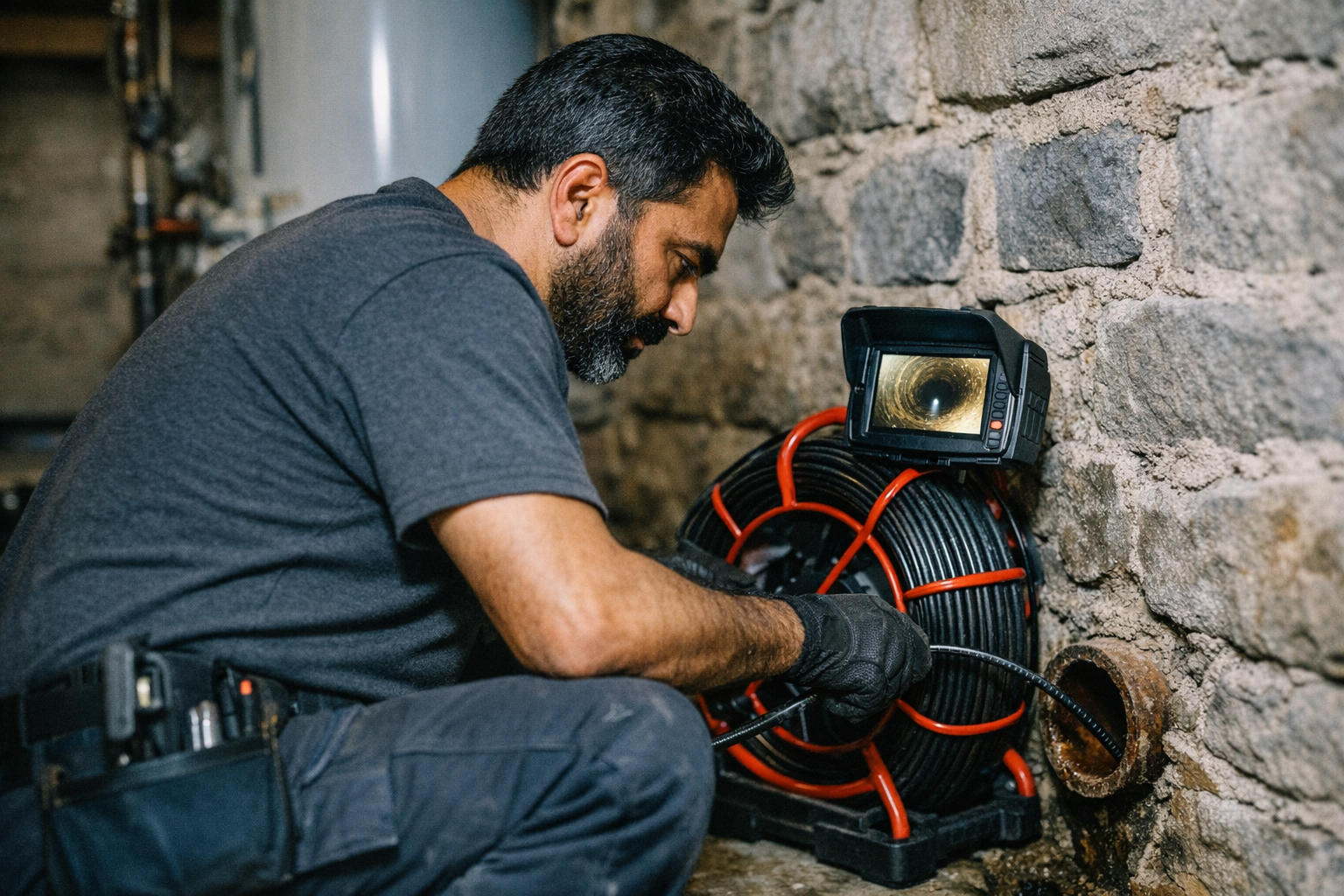
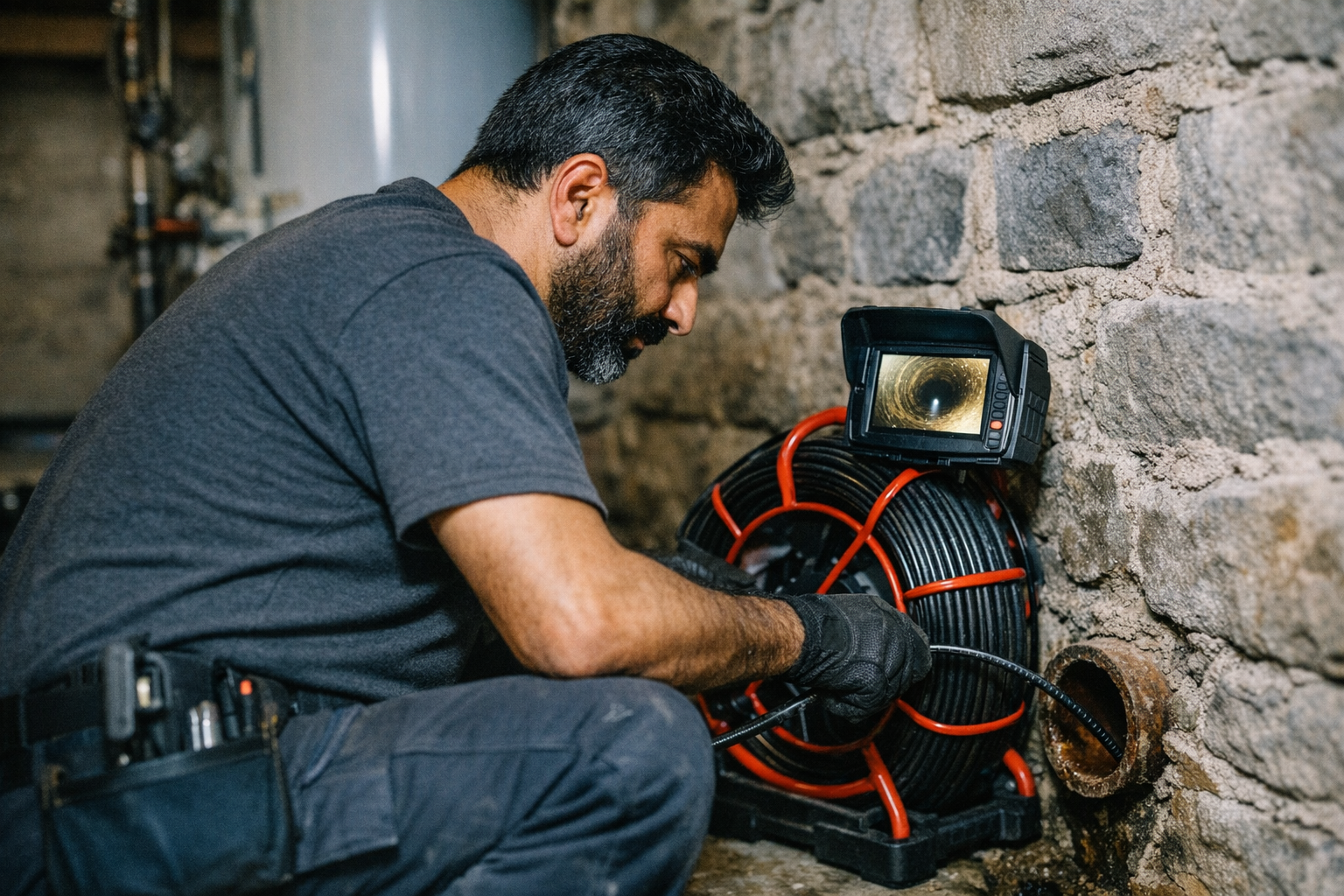
- The camera answers three questions a snake cannot: what material, what condition, and where exactly (measured to the foot with the on-screen counter and a locator sonde).
- Repeated liquid drain cleaner is the single most expensive homeowner habit we see. The lye attacks rubber trap gaskets and turns a snake job into a trap replacement.
- You watch the monitor with us. Every line, live. You get the footage.
The Situation: Why a Drain Camera Inspection in an Older Home in Barrie or Simcoe County Gets Booked
If you own a pre-1975 house anywhere from Barrie’s west end to Painswick, Stroud, Orillia’s older core or a farm property outside Cookstown, and you have now paid to snake the same drain twice in twelve months, this section is written for you specifically. Not for someone in a 2019 Alcona subdivision with PVC to the street. The two houses fail in completely different ways, and the diagnostic path is different too.
Here is the part that surprises people. The snake was not doing a bad job. A cable with a cutting head genuinely opens the line. It just cannot tell you whether it opened a root ball, a grease shelf, or a hole in the pipe where the ground is washing in. Same feel through the cable. Wildly different repair.
Seasonality matters in this region more than most contractors admit. Roots in Simcoe County push hardest in late spring and early summer when the soil warms and the tree is drinking. Frost movement in a long freeze season shifts bedding under shallow laterals. That is why the classic pattern here is “backed up in May, backed up again in October,” not “backed up randomly.”
What We Found
On the typical older Barrie job, the first thing we find is not in the pipe. It is at the cleanout. Half the homes of this vintage in Barrie, Midhurst and Orillia either have no accessible main cleanout or have one buried behind a finished basement wall from a 1980s rec-room job. That decision alone dictates the day: with a proper cleanout, the camera goes in clean. Without one, we pull a toilet or enter through a floor drain, which limits how far and how straight the head can travel.
Second finding, almost every time: the line changes material partway out. Cast iron inside the foundation, vitrified clay from the wall to the property line, sometimes a stub of Orangeburg on homes built in a certain postwar window. You see the transition on the monitor as a lip. That lip catches paper. It is a chronic snag point long before it is a failure.
Third, the actual defect. In an aging clay lateral it is usually a root intrusion at a bell joint, and the camera shows it as a white fibrous curtain hanging from the top of the pipe with clear water running underneath. Cast iron shows differently: scale, tuberculation, a rough interior that has narrowed the effective bore and grabs everything that passes. And the one nobody wants, the belly, where standing water sits and the camera head submerges. On the screen the picture goes brown, then green, then nothing.
“The most useful frame of a camera inspection is rarely the clog. It’s the eight feet before the clog, where you can see whether the pipe wall is intact or whether soil is already showing through a crack. That’s the frame that decides whether you’re buying a cleaning or a repair.” – Matthew Allain, Licensed plumber and owner, Allain Plumbing and Drains
One more thing we look for that most write-ups skip. Rubber trap gaskets under the basement fixtures, and the inside of the trap arms. When a homeowner tells us they poured drain cleaner down the slow drain “a few times,” we check. Repeated caustic cleaner eats those gaskets, and a $12 bottle habit becomes a trap replacement in the four-hundred-dollar range. We have pulled traps that crumbled in hand. It smells like it sounds.
In a typical aging Barrie lateral, the camera finds three things: a material transition lip where cast iron meets clay, root intrusion at a clay bell joint, and the true condition of the pipe wall on either side of the blockage. Roots that regrow every spring point to a joint defect, not a one-time clog.
How We Solved It: The Drain Camera Inspection, Step by Step
A drain camera inspection in an older Barrie or Simcoe County home follows the same order every time, because skipping steps is how you end up filming mud. Here is the sequence we run, with the tools that actually come off the truck.
Walk the fixtures before touching the drain
We run water at every level and watch which fixtures respond. Upstairs sink drains fine, basement floor drain gurgles? That isolates the fault below the lowest branch. Two minutes here saves an hour of guessing.
Find or create a proper access point
The main cleanout is the preferred entry. If there isn’t one accessible, we discuss options before we cut or pull anything, including adding a cleanout, which pays for itself the second time you need service.
Clear and flush first, then film
A camera in a full line shows you brown. We cable the line with a sectional or drum machine, or jet it where warranted, then flush with clean water so the lens has something to see. Filming a dirty line is the number one reason a camera report is useless.
Push the self-leveling head out, slowly
Colour camera head with LED ring, self-leveling so the picture stays upright and you can read the water line at the bottom of the pipe. Slow travel is the whole trick. Fast pushes blur past the hairline cracks.
Read the counter and mark the defect
The on-screen footage counter tells us how far out the defect sits. We call it out loud, you see it on the monitor at the same moment. No mystery diagnosis delivered from a truck.
Locate from the surface with the sonde
The transmitting sonde in the camera head plus a handheld locator lets us mark the spot on the lawn or driveway with paint. If a dig is coming, this is what keeps the excavation small.
Hand over the footage and a plain-language plan
Recording goes to the homeowner. Then a written, upfront quote with the options ranked: maintenance cleaning, spot repair, or full replacement of the affected run. You decide, not us.
On the typical aging-line job the recommendation lands in the middle: mechanically cut the roots back to the pipe wall, film the joint to confirm the pipe is still structurally sound, and either put the line on a scheduled cleaning or open a small excavation to replace the one bad joint. Full replacement of a clay lateral is real work, and we only recommend it when the footage shows offsets, collapse or a belly holding water. Which we will show you on screen before we say the word.
Honestly, the step people underestimate is number three. We tried filming before a proper flush on a job years back to save the homeowner time. All it bought was a second visit. Now the line gets cleaned and flushed first, always.
The homeowner stops paying for a snaking every eight months and starts making a decision based on what the pipe actually looks like. In the typical outcome, a root-intruded clay joint gets cut back, filmed, and the homeowner chooses either an annual maintenance clean or a targeted spot repair at a marked location instead of a blind trench across the front yard.
The other result matters just as much: they now own footage of their sewer lateral. When they sell, or when a home inspector raises the question, they have the file. Nobody has to guess.
What a Camera Inspection Typically Costs in Simcoe County, and What You Get
Drain camera inspection pricing in the Barrie, Innisfil and Newmarket market typically falls in the $200-$400 range as a standalone visit, with the higher end reflecting jobs where access has to be created or the line needs cleaning before it can be filmed. Those are category norms for this region, not a quoted Allain Plumbing price. We give you a firm number before we start, every time.
| What the camera shows | What it usually means | Typical path forward |
|---|---|---|
| White fibrous roots at a bell joint, clear flow underneath | Clay lateral, joint has opened enough for a root to enter | Mechanical root cutting plus scheduled maintenance, or spot repair of the joint |
| Rough, flaking, orange interior with narrowed bore | Cast iron scale build-up, common in pre-1970s Barrie and Orillia homes | Descaling or jetting; replacement if the wall is compromised |
| Camera submerges mid-run, then surfaces | A belly holding standing water, often from settled bedding | Excavate and re-lay that section; cleaning alone will not fix grade |
| Half-moon shadow where two pipe ends no longer align | Offset joint from frost movement or settlement | Locate with sonde, mark, open a targeted excavation |
| Soft, oval, delaminating pipe wall | Orangeburg (tar-paper pipe) on certain postwar builds | Plan replacement; these do not get better |
| Wipes and grease shelf, otherwise clean pipe wall | Usage problem, not a pipe problem | Drain cleaning plus a conversation about what goes down the toilet |
A note for rural properties, because Simcoe County has a lot of them. If the house is on a septic system outside Cookstown, Angus, Alliston or in the townships around Orillia, a backup at the house is not automatically a lateral defect. A saturated bed or a full tank pushes back toward the house and looks identical from the basement floor drain. The camera tells us which side of the tank the problem sits on, and that determines whether you call a plumber or a septic hauler. Getting that wrong costs people money every year.
What This Means for Older-Home Owners in Barrie and Simcoe County
Lesson one from this job: repeat snaking is a diagnostic result, not a failure of the plumber. If a line backs up twice in a year, the pipe is telling you something structural. A drain camera inspection in an older Barrie home converts that repeating expense into a one-time decision. The cost of two extra emergency clears usually exceeds the cost of the inspection that would have prevented them.
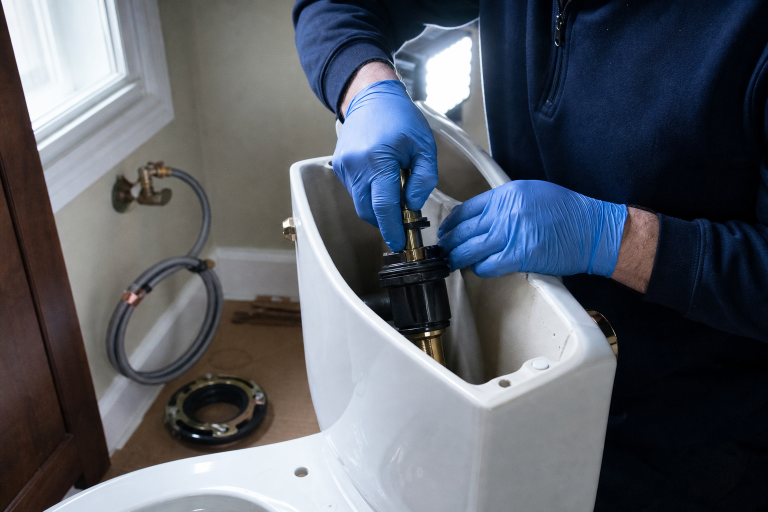
Lesson two, and this is the one that costs the most money in this region: stop pouring caustic drain cleaner into a slow drain. The lye attacks rubber gaskets in the trap. What starts as a slow basement sink becomes a trap replacement typically in the $400 neighborhood, and the original clog is still sitting out in the line where the chemical never reached it. Same category of mistake as ignoring a slow toilet refill, where a fill valve replacement around $35 in parts becomes a $300-plus tank-to-bowl gasket job once the tank seal lifts. Small things left alone in old houses do not stay small.
Lesson three is about the geography. Buyers moving from an Alcona or Bradford subdivision into an older Barrie, Midhurst or Orillia home carry over assumptions that do not apply. A newer PVC lateral with glued joints has no bells for roots to enter. A 1962 clay lateral does, and there is a mature maple in the front yard. That is not a defect in the house. It is a maintenance category the previous house never had.
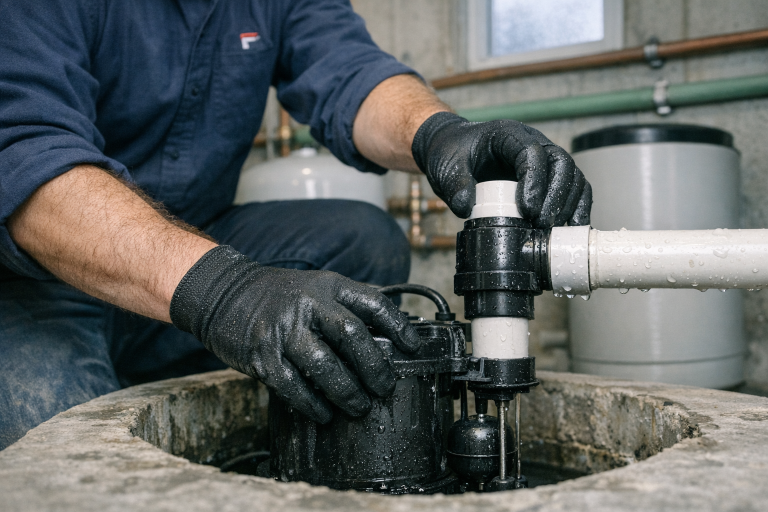
And if you are the seasonal property owner opening a Lefroy or Innisfil lakeside place in spring, the smart order of operations is camera first, then everything else. A line that sat dry all winter with a frost-heaved joint will show you nothing until the day the whole family arrives and four people shower. We would rather film it in April than pump the basement in July. That is also why sump pump service and frozen pipe protection belong on the same spring visit for those properties.
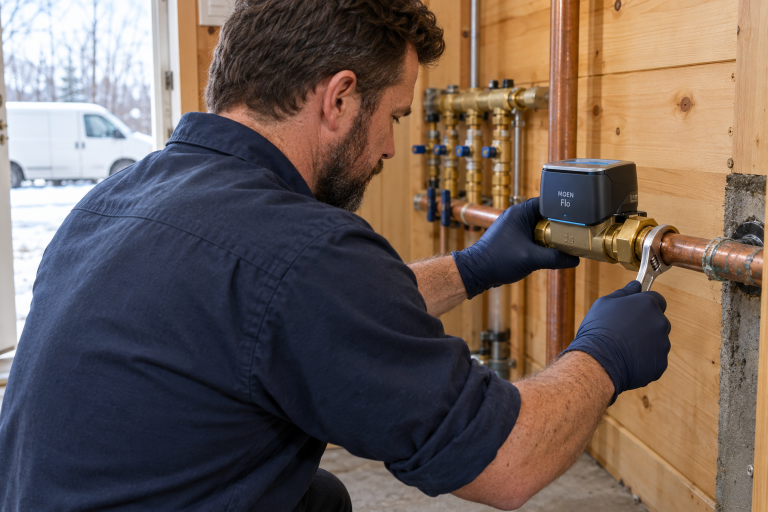
One last practical note, unrelated to the drain but related to the same instinct. We get emergency calls every month from half-finished DIY shutoff valve swaps where the valve broke off and the water would not stop. Isolate the main before you touch a valve. If you are not certain where the main shutoff is, find it today, not during the flood. A Moen Flo smart water monitor is worth considering for anyone who leaves an older home unoccupied for stretches, because it will close the main for you when you are not there to do it.
FAQ
My line was snaked twice this year. Do I still need a camera inspection, or is snaking enough?
Two snakings in twelve months on the same line is the clearest signal there is that a camera inspection is warranted. A cable clears the obstruction but cannot report pipe material, cracks, offsets or a belly, so you keep buying the same clear over and over. A standalone camera inspection in the Barrie and Innisfil market typically runs $200-$400 and usually costs less than the third emergency clear.
Can you run the camera if my Barrie home has no accessible main cleanout?
No accessible cleanout is common in pre-1975 Barrie, Midhurst and Orillia homes, and yes, we still have options. We can enter through a pulled toilet or a floor drain, though both limit reach and camera angles, or we can install a proper cleanout so every future service call is faster and cheaper. We price that option before touching anything, and adding a cleanout is usually the better long-term move on a house you intend to keep.
The camera showed roots at a joint. Do I have to replace the whole sewer lateral?
Root intrusion at a single clay bell joint rarely requires replacing the whole lateral. If the footage shows the surrounding pipe wall intact, the usual path is mechanical root cutting plus a maintenance schedule, or a targeted spot repair at the joint we mark from the surface with the sonde locator. Full replacement gets recommended when the camera shows multiple offsets, a collapse, a water-holding belly, or Orangeburg pipe.
I am on a septic system outside Cookstown. Will a drain camera inspection tell me anything useful?
A drain camera inspection on a rural Simcoe County septic property is genuinely useful because it separates a house-side problem from a tank-side problem. The camera confirms whether the building drain and the run to the tank are clear and structurally sound, which tells you whether you need a plumber or a licensed septic hauler. That distinction alone prevents a lot of wasted service calls around Cookstown, Angus and Alliston every spring.
Sources
- Ontario Building Code requirements for drainage, cleanouts and plumbing systems – Government of Ontario, Ontario’s Building Code
- Sewer lateral and private drain connection responsibility for property owners – City of Barrie, Water and Wastewater
- Septic system maintenance and homeowner responsibilities in Ontario – Government of Ontario, Septic Systems
- Smart water shutoff and leak monitoring product information – Moen Flo
Allain Plumbing
Serving Barrie, Innisfil, Alcona, Stroud, Bradford, Cookstown, Angus, Alliston, Midhurst, Newmarket, Aurora and Orillia.
Book a Drain Camera Inspection and Watch the Screen With Us →