

Tank vs Tankless Water Heater in Aurora: How We Decide Which Fits the House
Last updated: September 29, 2026
Published September 29, 2026 · Updated September 29, 2026
For the tank vs tankless water heater Aurora home, which is better question, the answer depends on the house. A properly sized condensing tankless unit from Rinnai or Navien is the better choice when the home has enough gas supply, a workable sidewall vent path, and soft or treated water. A Bradford White or Rheem tank is the better choice when the gas line, the venting, water hardness or winter power outages work against tankless.
That range of housing is what makes the decision harder here than in a street of identical houses. The older homes around the historic core near Yonge and Wellington, the subdivisions built around them over several decades, and the newer builds on the edges of town each come with a different gas line, a different vent path and a different basement. If you own a home here, your rental tank is getting old, and you are deciding whether to replace it with another tank or switch to tankless, this article is for you.
- A tankless water heater heats water only as it flows. Its output is limited by how many degrees it has to raise the water, and incoming water in a York Region winter is at its coldest.
- A storage tank from Bradford White or Rheem holds a set amount of hot water. How much it can deliver in a busy hour is shown by its first-hour rating, and it reheats after it is drawn down.
- Gas supply is the most common reason tankless doesn’t work in a house. A whole-house tankless unit burns far more gas at full firing than a typical tank, so both the gas piping and the Enbridge Gas meter need to be checked.
- Power outages matter in Simcoe County and York Region winters. A chimney-vented tank with a standing pilot keeps heating without household power, while power-vent tanks and gas tankless units stop.
- Hard water leaves scale inside a tankless heat exchanger. Rinnai and Navien both set water quality and maintenance expectations in their manuals and warranty terms.
- Cheap box-store import tankless units are the ones we most often see stuck waiting on parts that aren’t stocked. We recommend Rinnai or Navien from day one.
- Aurora is a town in York Region on Yonge Street, at the northern edge of the GTA, with Newmarket directly to the north.
- Aurora GO Station is on GO Transit’s Barrie line.
- Part of the town sits on the Oak Ridges Moraine.
- Housing ranges from older homes in the historic downtown near Yonge and Wellington to subdivisions built over the past several decades.
- Natural gas comes from Enbridge Gas, and municipal drinking water is supplied through York Region, which publishes water quality reports.
Why Is the Tank vs Tankless Water Heater Choice Different in an Aurora Home?
Choosing between a tank and a tankless water heater in Aurora is different because the town has three generations of housing side by side, and each one handles gas piping, venting and basement layout its own way. Two homes a few minutes apart can get opposite recommendations. That is normal here.
Older homes near the historic core
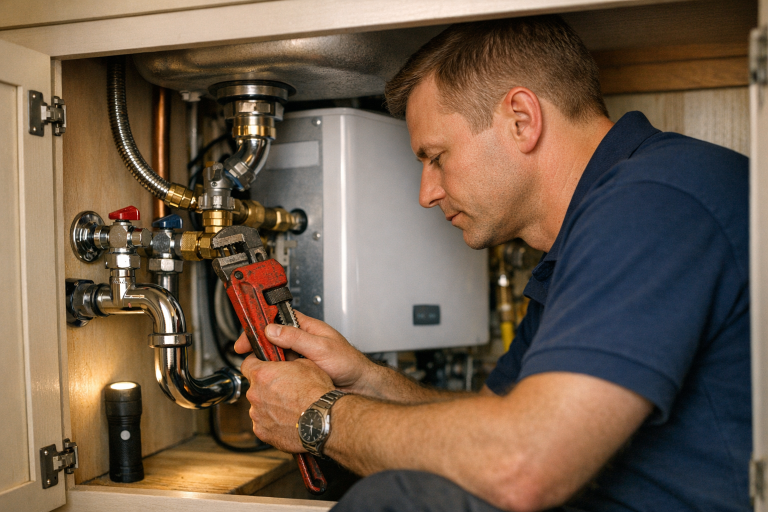
Older houses near the downtown core often vent the water heater up a chimney. Sometimes that chimney is shared with a furnace, and sometimes it was lined or relined at some point. When one appliance on a shared chimney changes, the venting for the other appliance has to be re-evaluated. Taking a water heater off a shared chimney is not a simple unplug-and-go job.
These basements also tend to have gas piping that has been added to over the years, one appliance at a time. Before we promise anyone endless hot water from a tankless unit, we trace that piping from the meter.
Subdivision homes built through the late 20th century
The typical subdivision house here has a rented tank, either chimney-vented or power-vented, next to a furnace in a basement that the owners have finished or want to finish. The gas line was sized for a furnace and a tank, not for a furnace and a tankless unit running at full fire together. Floor space is valuable in these basements, which is a real point in favor of a wall-hung tankless heater.
Newer builds on the edges of town
Newer homes usually already have a high-efficiency furnace venting out the side wall in plastic pipe, so adding a condensing tankless unit is often easier. These homes also tend to have more bathrooms. More bathrooms means more fixtures running at the same time, and that is exactly the load that shows whether a tankless unit was sized correctly.
The winter factor every house shares
Put your hand on the cold water line coming into a basement here in February and you will feel the issue right away. The water arriving at the heater is much colder than in August, so a tankless unit has to raise it more degrees, and it delivers less hot water per minute as a result. A tank has the same cold water coming in, but it has hours to heat its stored supply before the morning rush.
What Water Heater Problems Do We See Most in Aurora Houses?
The water heater problems we see most often in York Region homes fall into five groups: tankless units that don’t get enough gas, vent terminals in the wrong spot, scale from untreated water, cheap import units that can’t get parts, and half-finished DIY shutoff valve jobs. Each one can be avoided if the right question is asked before the install.
Tankless units that don’t get enough gas
A tankless heater that doesn’t get enough gas shows it in a few ways: the shower temperature swings, error codes appear when the furnace and the heater fire at the same time, or the unit never quite reaches its setpoint on a cold morning. The heater itself is usually fine. The pipe feeding it was sized for the old tank.
Correct gas pipe sizing depends on the length of the run, the number of fittings and the total load of every appliance in the house. We work that out for the specific house. We don’t guess it from a chart on a spec sheet, and sometimes Enbridge Gas has to confirm that the meter can carry the new load.
The vent path nobody checked
A condensing tankless unit vents through the side wall in the plastic pipe material the manufacturer specifies. The terminal has to meet clearances from windows, doors, the gas meter, decks and the expected snow line. Those clearances come from the manufacturer’s manual and the applicable code, so confirm them with your installer instead of relying on a number from a forum.
In this climate, snow drifts against a north-facing wall and frost builds on a vent terminal on the coldest nights. A terminal that looks fine in September can be buried by January. Condensing units also produce condensate, which needs a proper route to a floor drain or a condensate pump, usually through a neutralizer.
Scale inside the heat exchanger
Hard water leaves a chalky white crust, and inside a tankless heat exchanger it collects in narrow passages where it cuts efficiency and triggers errors. Tanks get scale too, but it mostly settles as sediment at the bottom, where it rumbles and pops as the burner fires. We test the water, and when hardness calls for it, we pair the heater with a water softener installed and sized for your household.
The cheapest box-store tankless
The call we get most often about tankless comes from a homeowner who bought the cheapest box-store import unit and now has an error code. Most of those units use parts that are not stocked locally. The house goes without hot water while a part ships, and sometimes the repair makes less sense than a replacement. That is why we recommend Rinnai or Navien from day one.
The half-finished shutoff valve
Replacing the shutoff valve on the cold water supply to a water heater seems like an easy DIY job until the old valve breaks off in your hand. We get two to three emergency calls a month from half-finished DIY valve replacements where the homeowner never shut off the main and could not stop the water. Find and test your main shutoff first, and keep our 24/7 emergency plumbing line handy if the main won’t close.
“The heater is rarely the weak link in a tankless install. The gas pipe feeding it and the wall it vents through decide whether you get steady hot water on a February morning, so we look at those before anyone opens a brochure.”Matthew Allain, Licensed plumber and owner, Allain Plumbing and Drains
How Do We Decide Between Tank and Tankless for an Aurora House?
We decide between a tank and a tankless water heater for a house in this part of York Region by going through six checks in the basement and on the outside wall before we talk about brands. The checks take one visit. After that, the answer is usually obvious.
We’ll admit something: tankless is the more interesting install for us. That is exactly why we make ourselves argue against it first.
Map the peak demand
We ask what runs at the same time on your busiest morning: showers, a tub, the dishwasher, the laundry. A commuter household racing to catch an early GO train uses water very differently from a retired couple.
Trace the gas line to the meter
We check pipe size, run length and every appliance on the line. If the meter’s capacity is in doubt, Enbridge Gas gets involved before we commit to tankless.
Walk the outside wall
We look for a vent terminal spot that clears windows, doors, the meter and decks, and that stays above winter snow. If there is no good spot, a tankless unit is the wrong choice for that house.
Test the water
Hardness affects how often a tankless unit needs descaling and whether a softener belongs in the plan. Private wells, which we see more often north into Simcoe County, can be much harder than municipal supply.
Ask about power outages
Gas tankless units and power-vent tanks both need household power. If hot water during a winter outage matters to you, a chimney-vented tank with a standing pilot, or a generator plan, stays on the table.
Read the rental contract
If the current tank is rented, the agreement sets the buyout and removal terms. We would rather you learn those terms before install day than on it.
| Factor | Tank (Bradford White, Rheem) | Tankless (Rinnai, Navien) |
|---|---|---|
| How hot water is delivered | A stored volume, then a recovery period | Continuous, limited by flow and temperature rise |
| Winter behavior | Stored water is already hot when the rush starts | Less hot water per minute as incoming water gets colder |
| Power outage | Chimney-vented standing-pilot models keep heating; power-vent models stop | Stops without household power |
| Gas supply | Usually works with existing piping | Often needs larger piping and a meter check |
| Venting | Chimney or power-vent | Sidewall plastic vent plus a condensate drain route |
| Hard water | Sediment at the bottom; flush and check the anode | Scale in the heat exchanger; descale on the manufacturer’s schedule |
| Floor space | Takes up floor space in the mechanical room | Wall-hung, frees up floor space |
| Wins when | Gas or venting is limited, outages worry you, or you won’t keep up with maintenance | Gas and venting work, the water is treated, and you want space and continuous supply |
The brands we match to these houses
For tankless, we install Rinnai and Navien. Navien’s NPE-A2 series includes a built-in recirculation pump and a small buffer tank. That helps in long, spread-out homes where the far bathroom otherwise waits a while for hot water.
For tanks, we install Bradford White and Rheem. (Bradford White has no connection to Bradford, the town up the road, although we hear that joke a lot.) In a finished basement, whichever heater goes in, we often suggest a Moen Flo smart water monitor on the main line so a leak shows up on your phone before it ruins the carpet.
A tank vs tankless decision in York Region comes down to six checks: peak demand, gas supply, vent path, water hardness, outage tolerance and the rental contract. Rinnai or Navien wins when all six line up. Bradford White or Rheem wins when any one of them fails.
Is Tankless Worth It for an Aurora Home Compared With a Rental Tank?
Whether tankless is worth it for a home here depends mostly on three things: how long you plan to stay, how much gas and venting work the install needs, and what your current rental agreement says. A tankless install where the gas line and vent path already work is a very different job from one that needs new piping from the meter and a new wall penetration.
Many Ontario homes have a rented tank, and Enercare and Reliance are the names most homeowners find on the sticker. Each provider sets its own terms for buyout and removal. Read your agreement before comparing options.
We don’t publish prices, because the gas line and vent path change the job so much from house to house. We quote upfront after the site check, and you can ask us for pricing on both a tank and a tankless option for the same home. Start with our water heater repair and installation page or contact the Allain Plumbing crew directly.
What about shops and small offices?
A small office on Yonge Street with one staff washroom and a restaurant kitchen running dish cycles all day need very different equipment. The office may only need a small tank, or a point-of-use heater at the sink. The restaurant needs a system sized for sustained demand and for health inspection temperature requirements, which is a separate conversation from a residential choice between tank and tankless.
Our take after years of plumbing across York Region and Simcoe County
In our experience, homeowners put too much weight on the phrase “endless hot water” and not enough on the maintenance a tankless unit needs. A Rinnai or Navien that gets descaled on schedule is a great heater. The same unit, ignored for years on hard water, becomes a source of error codes.
What actually matters is sizing for the coldest incoming water of the year, a gas line that can carry the load, and a brand with parts support you can get locally. The heater brochure matters least. If you ask us which water heater is better for a northern GTA house, our honest answer is that the right one is whichever your gas meter, your outside wall and your maintenance habits can support.
We would tell a friend one thing: if you know you won’t flush it, buy a good tank. And if you also own a seasonal place north toward Orillia, a tankless unit in an unheated cottage has to be drained or freeze-protected before winter, every year, without exception.
What Do Aurora Homeowners Ask About Tank vs Tankless?
Will a tankless water heater keep up with an Aurora winter?
A tankless water heater in an Aurora winter delivers less hot water per minute than in summer, because the incoming municipal water is colder and the unit has to raise it more degrees. A correctly sized Rinnai or Navien condensing unit still handles a typical family morning, but two showers and a dishwasher running at once in January will expose an undersized unit. We size for the coldest incoming water of the year, not the average.
Can I switch from a rented tank to a tankless heater in my Aurora house?
Switching from a rented tank to tankless in an Aurora house is a common job, but read your rental agreement first, because providers such as Enercare and Reliance set their own buyout and removal terms. Allain Plumbing handles the tankless install, including the gas and venting work, and you arrange the rental return with the provider. Call the provider before install day so the old tank has somewhere to go.
Do I need a water softener with a tankless water heater in York Region?
Whether a tankless heater in York Region needs a water softener depends on how hard your water tests, and a private well can be much harder than municipal supply. Scale builds up fastest inside a tankless heat exchanger, and Rinnai and Navien both tie water quality and descaling to their maintenance instructions and warranty terms. We test the water before recommending a softener, a scale filter or neither.
Which tankless brands does Allain Plumbing install in Aurora?
Allain Plumbing installs Rinnai and Navien tankless water heaters in Aurora homes because both brands have established Canadian parts and service support. With the cheapest box-store import units, the pattern we see is an error code followed by a part that isn’t stocked locally, and the house goes without hot water while it ships. For homes that are better served by a tank, we install Bradford White and Rheem.
Sources
- Natural gas service and meter capacity questions for York Region addresses: Enbridge Gas
- Regulation of fuel safety and gas appliance installation in Ontario: Technical Standards and Safety Authority (TSSA)
- Drinking water quality reporting for York Region municipalities: The Regional Municipality of York
- Tankless venting, condensate and water quality requirements: Rinnai Canada and Navien
Allain Plumbing
🎧 Listen to article
- Rinnai vs Navien Tankless Water Heater: Which Brand We See Perform Better in Simcoe County Homes
- Bradford White vs Rheem Tank Water Heater: Which Holds Up Better in Simcoe County Hard Water Conditions
- Kohler vs American Standard Toilet: Which Brand Holds Up Better in a High-Use Bradford Family Home
- PEX vs Copper Re-Pipe in a Barrie Century Home: Which Way We Go and Why
- Moen vs Delta Faucet: Which Brand We Recommend for Hard Water in Innisfil and Alcona Homes