Inside a Burst Pipe Emergency Call in Barrie’s Painswick Neighbourhood: What a Typical Winter Job Looks Like, Start to Finish
Last updated: August 21, 2026
Published August 21, 2026 · Updated August 21, 2026
Burst pipe emergency repair Barrie Simcoe County winter calls follow the same fixed sequence every single time: kill the water supply, open the lowest fixture to drain pressure, locate the split, thaw the frozen section without flame, cut out the damaged run, press or expand in a new section, then pressure test before anyone touches a piece of drywall. The pipe is rarely the surprise. Where the cold got in almost always is.
- The burst almost never happens at the ice plug. It happens between the ice and a closed faucet, where the pressure has nowhere to escape.
- In Painswick, Alcona and Stroud, the two most common freeze points are the bathroom floor over an unheated garage and the laundry line run through an exterior wall.
- Shutting the main off buys you more than any towel ever will. On a well system, that means the pump breaker plus an open faucet, not a curb stop.
- Typical category ranges in our region: a single accessible copper split usually falls in the $350-$700 band, while the same split behind finished drywall commonly runs $600-$1,400 once access and patch prep are included. Confirm any number with your plumber before work starts.
- Insulation alone does not stop freezing. Insulation slows heat loss. It does not add heat.
What We Found: Burst Pipe Emergency Repair in a Barrie Simcoe County Winter
On a Painswick burst pipe emergency repair, the water is almost never coming from where the homeowner says it is. Water travels along the top of drywall, finds a light fixture or a seam, and drops through in a spot that has nothing to do with the failed section of pipe. The first thing we do after the main is shut is stop looking at the puddle and start looking at the coldest wall in the house.
In this style of home, built through the late 1990s and 2000s across Painswick, Alcona and the Stroud corridor, the supply lines for the second-floor bathroom often run through the floor cavity above the garage. That cavity is insulated. It is not heated. Add a garage door left open for ten minutes on a windy morning and that space drops fast.
What you find when you cut in is a copper line with a longitudinal split, usually a couple of finger-widths long, the metal bulged out like it had been pried open from inside. That split is downstream of the ice, not at it. Water expanded as it froze, pressure built between the growing ice plug and the closed faucet upstairs, and the weakest section of copper let go. The homeowner opening the tap is what turned a frozen pipe into a flood.
“The pipe that bursts is almost never the pipe that froze. People find the ice, thaw the ice, and then wonder why the ceiling is wet three feet away. Once you understand that the damage happens where the pressure got trapped, you stop hunting in the wrong place and you find the split in about five minutes.” – Matthew Allain, Licensed plumber and owner, Allain Plumbing and Drains
The other thing we check on arrival, every time: whether it is one line or the whole run. If the garage-ceiling line froze, the hose bib stub on that same exterior wall very likely froze too. Honestly, that second failure catches more people than the first one, because it does not show up until the main gets turned back on.
How We Solved It, Step by Step
A frozen and burst pipe repair in Barrie runs in a set order, and skipping ahead is how a repair turns into a second callback. Here is the sequence we work in on a typical winter emergency in Painswick, Alcona, Midhurst or anywhere else in Simcoe County.
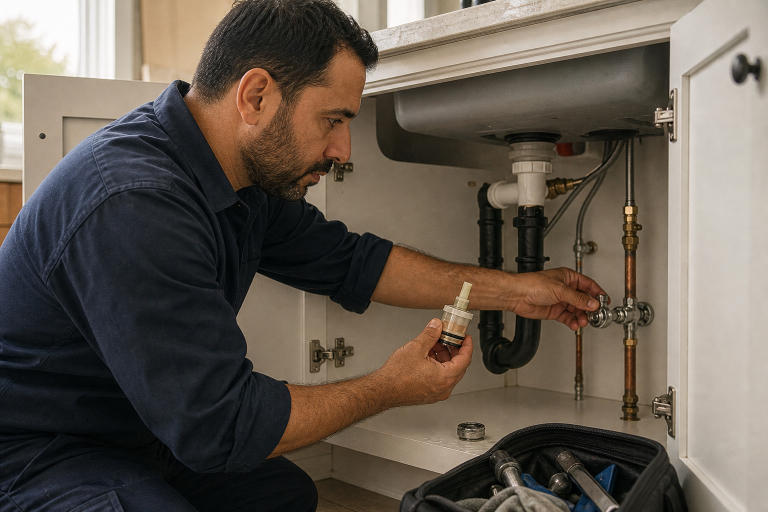
- Isolate the water before anything else. On municipal service in Barrie or Bradford, that is the main shutoff valve where the service enters the house, usually beside the meter. On a well system in Cookstown, Angus or rural Innisfil, there is no curb stop to lean on: we shut the breaker to the well pump, then open a low fixture to bleed the pressure tank down.
- Drain the system down. Lowest fixture first, then work upward, and open the exterior hose bibs if they are accessible. Less water sitting in the pipe means less water on the floor when we cut.
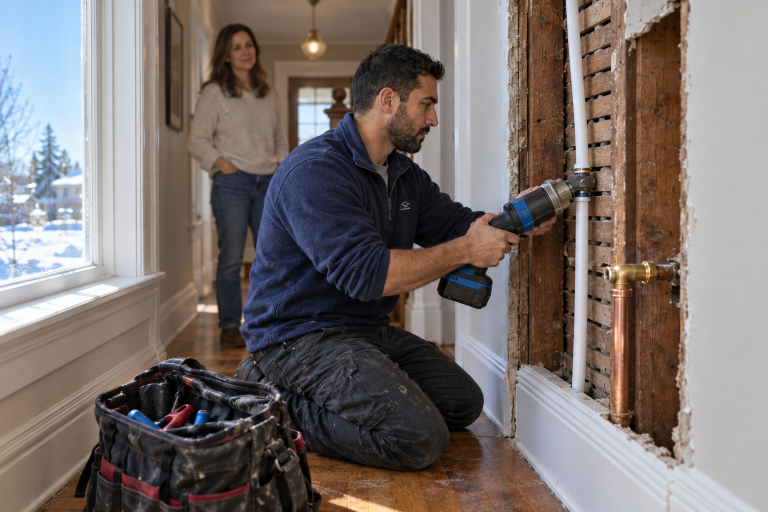
- Find the split, not the ice. We trace the wet path back to the cold cavity, and where the ceiling is finished we make a controlled access cut rather than a demolition hole. Neat access cuts save the homeowner real money at the drywall stage.
- Thaw with controlled heat only. Heat gun on low, heat lamp, or warm-air movement into the cavity, with a fixture open so meltwater has somewhere to go. Never a torch, never a propane heater aimed into a stud bay. Open flame in a wall cavity is how a plumbing call becomes a fire call.
- Cut out the failed section and inspect either side of it. Copper that has been stretched once is compromised past the visible bulge. We remove back to sound pipe, deburr, and clean the ends properly.
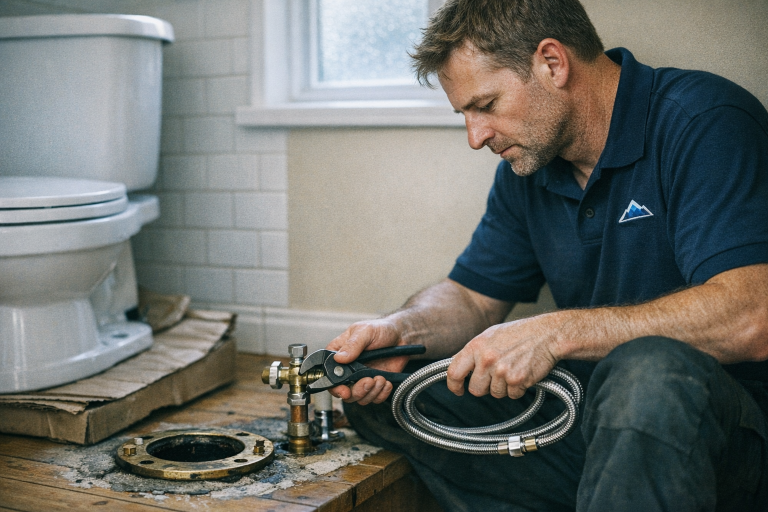
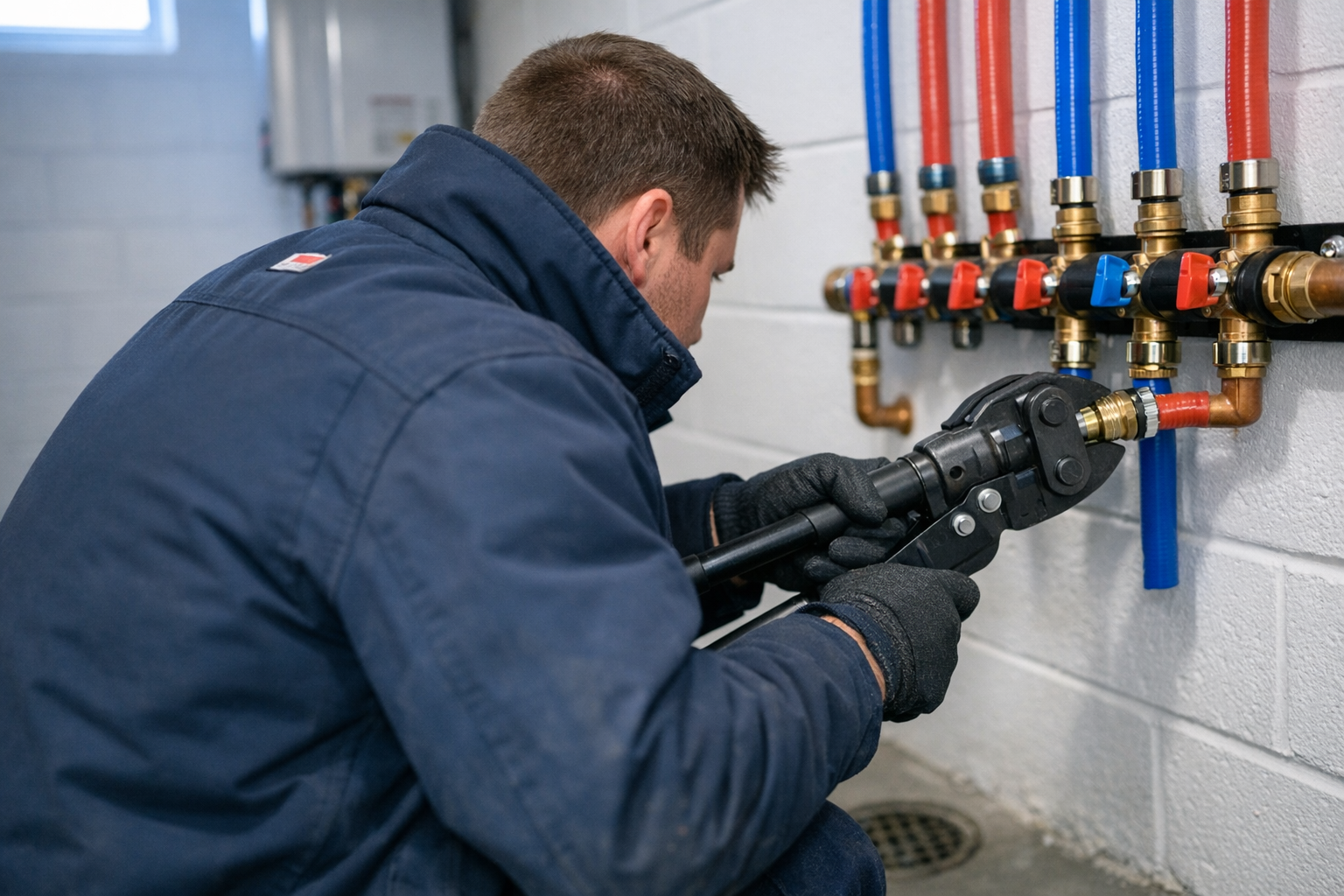
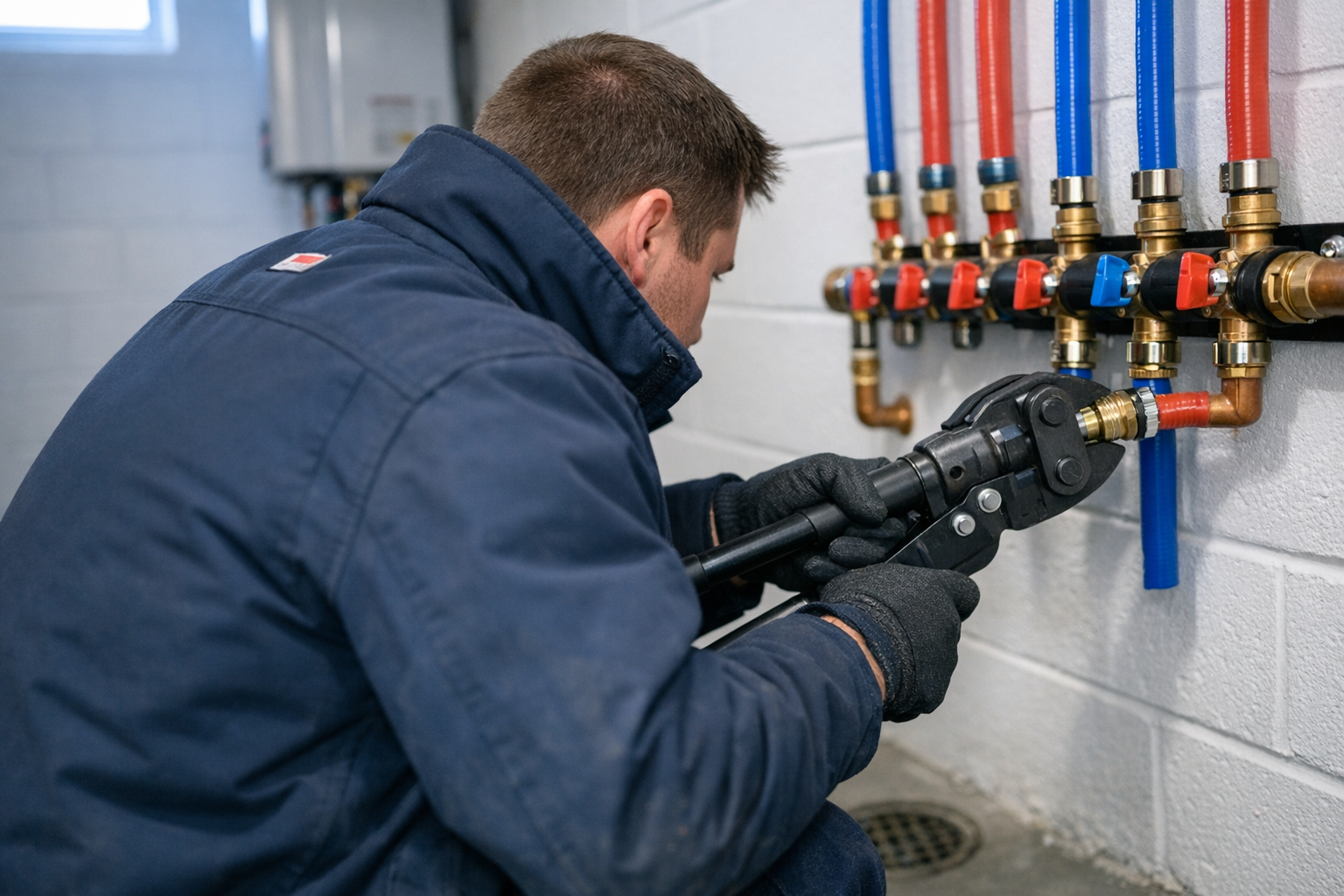
- Repair with press or expansion fittings, not a torch on a wet line. A RIDGID press tool with Viega ProPress fittings makes a permanent joint on a line that will not fully dry out, which matters in an emergency. Where we are converting a freeze-prone run, PEX with expansion fittings tolerates a future freeze far better than rigid copper. Push-to-connect fittings have their place as a serviceable, accessible repair; talk to your plumber about what is appropriate for a concealed location and confirm against the Ontario Building Code.
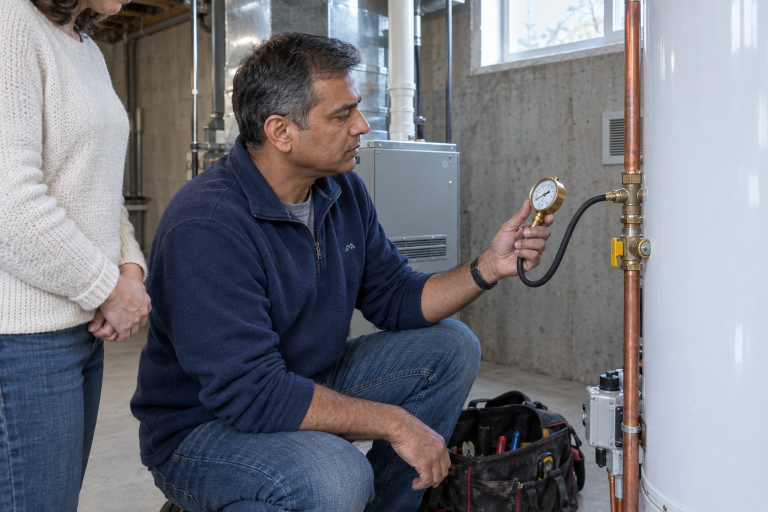
- Re-pressurize slowly and purge air. We crack the main open gradually, then open fixtures one at a time from the lowest to the highest to push the air out. Fast re-pressurization is how you find the second failure the hard way.
- Hold pressure and watch every joint. We stay on it while the system settles and inspect the entire cold run, including the hose bib stub, the laundry box and any line sharing that exterior wall.
- Fix the cause, not just the pipe. That means rerouting the line into conditioned space where the framing allows, adding self-regulating heat cable, sealing the air leak at the rim joist that let the cold in, or all three. A repaired pipe in the same cold cavity is a scheduled callback for next January.
- Document for insurance. Photos of the split, the location, the water path, and the repair. Homeowners dealing with a water damage claim need that file, and restoration is a separate trade from plumbing.
A winter burst pipe repair in Barrie is isolate, drain, locate, thaw with controlled heat, cut back to sound pipe, press or expand a new section in, then re-pressurize slowly while watching every joint. The repair itself is often the fastest part. Finding the cold-air path that caused it is the part that keeps it from happening again.
What the homeowner should do in the first ten minutes
Shut the main off
Know where it is before you need it. Municipal service: beside the meter. Well system: the pump breaker, then open a tap.
Open a low fixture
Basement laundry tub or utility sink. It drops the pressure in the system so the split stops feeding.
Kill power to anything wet
If water is running near a panel, light fixture or furnace, shut the affected circuit off from a dry standing position and call an electrician if you are unsure.
Do not thaw with a torch
A hair dryer or space heater aimed at the accessible section is fine. Open flame near framing and insulation is not.
Photograph everything before cleanup
Wide shot, close shot, ceiling, floor. Your insurer will ask, and the pictures are worth more than your memory at 6 a.m.
What This Means for Simcoe County Homeowners
If you own a two-story in Painswick or Alcona with a bathroom sitting over the garage, you are the exact profile this article is written for. Not a downtown Toronto condo owner with everything in interior walls. You have a long freeze season, wind exposure, and at least one plumbing run passing through a space that is insulated but unheated. That combination is the single most common source of a burst pipe emergency repair in a Barrie Simcoe County winter.
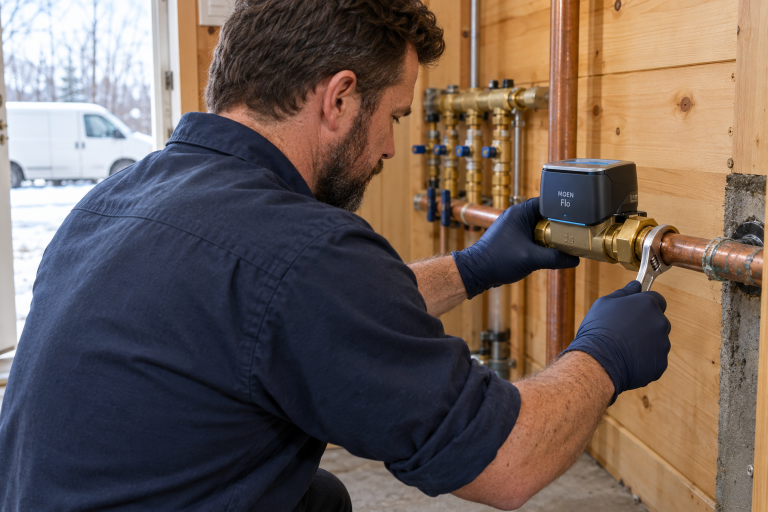
The second profile is the seasonal owner. If you have a place near Lefroy, Innisfil Beach or up toward Orillia that sits empty through part of the winter, your risk is different: a thermostat set too low, a furnace that quits in February with nobody there, or a system that was never properly drained in the fall. A Moen Flo smart water monitor with automatic shutoff is genuinely useful on those properties, because it can cut the supply while you are two hours away. On a well system it should be installed downstream of the pressure tank; have your plumber confirm placement for your setup.
Here is the pattern we see across the different housing stock in our service area. Same physics, different weak point.
| Property type | Where it usually freezes first | The fix that actually holds |
|---|---|---|
| 1990s-2000s two-story, Painswick / Alcona / Stroud | Bathroom supply run in the floor cavity over an unheated garage | Reroute into conditioned space where framing allows, seal the rim joist, add heat cable |
| Century farmhouse, Cookstown / Angus / rural Innisfil | Crawlspace runs and the line from the pressure tank | Insulate and air-seal the crawl, keep the well room above freezing, heat trace exposed runs |
| Seasonal / lakefront, Lefroy and Innisfil shoreline | Whole system, because it was never drained properly in fall | Proper winterization, low-temp alarm, smart shutoff like Moen Flo |
| Newer build, Bradford / Alliston / Angus | Hose bib stub through the rim joist, garage wall plumbing | Remove hoses in fall, shut and drain the bib line, verify the frost-free bib pitches to drain |
| Older Barrie or Orillia bungalow with an addition | Lines run through the unheated addition floor or a cantilever | Air-seal the cantilever, reroute or re-pipe the exposed section |
One thing that surprises people: insulation wrapped around a pipe in an unheated cavity can make things worse, not better. It slows heat loss, but it also blocks whatever warmth was leaking in from the house. If nothing is producing heat in that space, insulation just makes the pipe cold more slowly and then keeps it cold longer. Heat trace plus insulation works. Insulation on its own in a truly unheated bay often does not.
What Homeowners Get Wrong Before We Arrive
The most expensive mistake in a winter burst pipe emergency is a DIY valve swap attempted without isolating the main. We get two to three emergency calls a month from a half-finished DIY where the shutoff valve snapped off in someone’s hand and they could not stop the flow. That is not a plumbing job anymore, that is a flood with a deadline. If you are replacing a stop valve, the main comes off first, every time, no exceptions.
The winter-adjacent version of this shows up on the drain side. Homeowners pour chemical drain cleaner into a slow drain repeatedly, and the lye eats the rubber gaskets in the trap. A small clog we would have cleared with a cable or a camera becomes roughly a $400 trap replacement. If a drain is slow in January, get a drain cleaning and camera inspection done and watch the screen with us instead of buying another jug.
Two more small ones that turn into big ones. A slow-refilling toilet is usually about a $35 fill valve; ignored, it lifts the tank seal and becomes a $300-plus tank-to-bowl gasket job. And on the hot water side, the cheapest box-store tankless unit is a trap: most of the $1,500 import units have parts nobody stocks in Simcoe County, so a February error code means waiting on a shipment with no hot water. We recommend Rinnai or Navien from day one for exactly that reason, alongside Bradford White or Rheem on the tank side.
What a Winter Burst Pipe Typically Costs
Burst pipe repair pricing in Barrie and the surrounding Simcoe County towns is driven almost entirely by access, not by the pipe. The ranges below are category norms for our region, not a quote from Allain Plumbing. We give an upfront number on site before any work starts, and you approve it first.
| Scenario | Typical regional range | What drives it |
|---|---|---|
| After-hours emergency attendance and diagnosis | Typically $150-$300 | Time of night, travel distance |
| Frozen line thawed, no rupture | Typically $200-$450 | How buried the frozen section is |
| Single split, exposed basement or utility ceiling | Typically $350-$700 | Fitting type, length replaced |
| Split behind finished drywall or over a garage | Typically $600-$1,400 | Access cutting, reroute work |
| Re-piping a chronically freeze-prone run | Four figures, scope dependent | Length, routing, restoration |
| Water damage restoration and drying | Separate trade, often insured | Affected area, materials soaked |
The gap between the third row and the fourth row is the entire argument for calling before you open the tap. A frozen pipe caught frozen is a manageable bill. A frozen pipe that has already split and run for an hour is a plumbing job plus a restoration job plus a claim. Our 24/7 emergency plumbing line exists specifically for that first window.
FAQ: Frozen and Burst Pipes in Barrie and Simcoe County
My tap ran dry this morning but nothing is leaking yet. Should I keep the faucet open?
A dry tap on a below-freezing morning in Barrie means a frozen line, and yes, leave that faucet open. An open fixture gives melting ice and trapped pressure somewhere to escape, which is exactly what prevents the split. What you should not do is walk away and forget it. Shut the main if you cannot stay in the house, and call a plumber the same morning rather than waiting to see what happens tonight.
Where is my main water shutoff if I am on a well in rural Innisfil or Cookstown?
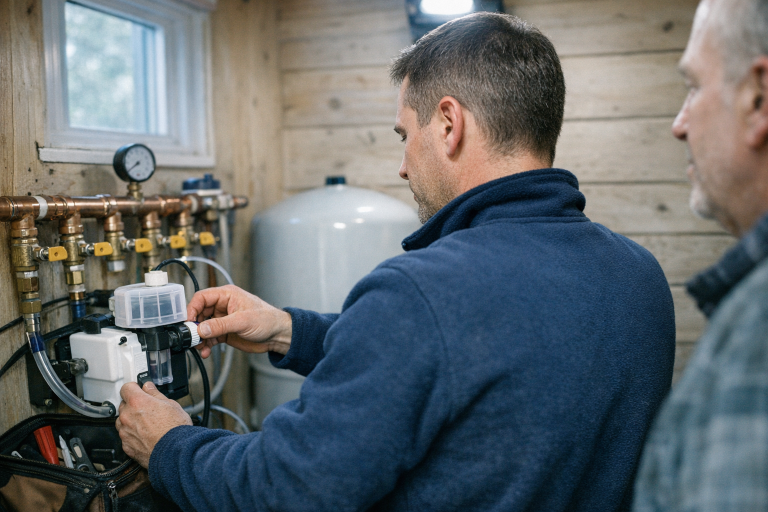
Well systems in rural Innisfil, Cookstown and Angus have no municipal curb stop, so the shutoff sequence is different: turn off the breaker feeding the well pump, then open a low fixture to bleed down the pressure tank. There is usually also a valve at the tank outlet feeding the house. Find and label both this week, before a January morning forces you to find them with a flashlight in a wet mechanical room. Our well pump and rural water visits include walking you through your own shutoffs.
Will my insurance cover a burst pipe over the garage in Painswick?
Most Ontario homeowner policies treat sudden and accidental water escape from indoor plumbing as covered, but coverage frequently hinges on whether the home was heated and whether a vacant property was properly winterized. That is why photos and a documented repair matter. Check your specific wording with your broker or the Insurance Bureau of Canada, and take pictures before you clean anything up.
Should I replace copper with PEX in a section that has frozen before?
PEX tolerates a freeze event better than rigid copper because it can expand somewhat and is less likely to split outright, which is why we often use it when re-piping a freeze-prone run over a garage or through a cantilever. It is not freeze-proof, though, and the fittings remain a weak point. The real fix is removing the cold, so we pair a re-pipe or reroute with air sealing and heat cable rather than treating the pipe material as the whole answer.
Sources
- Winter temperature context for Barrie and Simcoe County – Environment and Climate Change Canada, Canadian Climate Normals
- Plumbing installation requirements and permit questions in Ontario – Government of Ontario, Ontario Building Code
- Home water damage coverage and winterization conditions – Insurance Bureau of Canada
- Smart water shutoff product information referenced in this article – Moen
Allain Plumbing
🎧 Listen to article
- Inside a Drain Camera Inspection in Barrie’s West End: What a Typical Aging-Line Job Looks Like, Start to Fini
- Bradford White vs Rheem Tank Water Heater: Which Holds Up Better in Simcoe County Hard Water Conditions
- Drain Snaking vs Hydro-Jetting: Which Method Actually Clears Bradford and Cookstown Drain Clogs for Good
- A Customer Asked: “Our Orillia Cottage Pipes Froze Last March — How Do We Stop It Happening Again?”
- A Customer Asked: “Why Is My Sump Pump Running Every Few Minutes in My Alcona Home?” What We Usually Find