

A Customer Asked: “Our Orillia Cottage Pipes Froze Last March — How Do We Stop It Happening Again?”
Last updated: August 13, 2026
Published August 13, 2026 · Updated August 13, 2026
Stopping frozen cottage pipes in Orillia – how to prevent recurring freeze – comes down to three things done in the right order: eliminate the cold air path that caused the first freeze, remove the standing water from any line you cannot guarantee heat to, and put a monitored shutoff on the main so the next failure is a wet floor instead of a wet ceiling. Draining alone is not enough. Heat alone is not enough either.
- Pipes almost never freeze where the cottage is cold. They freeze where cold outside air reaches a pipe that the heated air cannot.
- March is prime freeze season in Orillia, not January. Thaw-freeze cycles and low snow cover on the crawlspace skirt do the damage.
- A proper fall drain-down means blowing the lines, dosing the traps with RV antifreeze and draining the water heater, not just opening the taps.
- If you heat the cottage remotely instead of draining it, a Moen Flo smart water monitor with automatic shutoff is the single highest-value device you can install.
- Self-regulating heat trace on the vulnerable run plus real insulation on the exterior side of the pipe beats “we leave a tap dripping.”
- Typical GTA and Simcoe County range for a professional seasonal winterization on a small cottage: roughly $250 to $450, versus a burst-pipe ceiling repair that routinely runs into the thousands.
The Short Answer
To prevent recurring frozen cottage pipes in Orillia, you need to pick a strategy and commit to it fully: either the cottage is fully drained and winterized every fall, or it is continuously heated and monitored all winter. The failures we get called to are almost always half-measures – the place was “mostly drained,” or the furnace was left on but nobody knew it quit in February.
If you drain: blow the lines with compressed air, drain the water heater, pour RV antifreeze into every trap including the shower and the floor drain, and shut and drain the pressure tank if you’re on a well. If you heat: insulate the exterior-facing pipe runs properly, add self-regulating heat trace to the one or two vulnerable sections, and install a Moen Flo smart water monitor with automatic shutoff so a burst line at 3 a.m. in February stops itself.
Drained cottage or heated cottage – pick one and do it completely. Half-drained is the condition that bursts pipes in Orillia every March. Professional seasonal winterization typically runs $250 to $450 in Simcoe County; a burst supply line above a finished ceiling does not.
The Full Answer
If you’re a seasonal owner with a Lake Couchiching or Orillia-area cottage that sits empty from November to May, and you’ve already had one burst, this section is written for you specifically – not for the year-round Alcona homeowner whose basement stays at 20°C. Your risk profile is completely different, and so is the fix.
1. Find out where it actually froze, not where it burst
Frozen cottage pipes in Orillia rarely split at the coldest point in the building. Ice forms at the cold spot, then pressure builds downstream between that ice plug and a closed faucet, and the pipe splits wherever the wall is thinnest or a fitting is weakest. That can be six feet away, in a joist bay that felt perfectly warm to you.
So before you spend a dollar on prevention, trace the run. On older Orillia and Ramara-side cottages, the usual suspects are the same every time: a supply line running through an uninsulated crawlspace, a line in an exterior wall behind a kitchen sink, a pipe crossing above an unheated porch, and a pressure tank sitting in a pumphouse or unheated corner. Cold air finds a path. Warm air does not.
“The freeze point is almost always an air-leak problem wearing a plumbing costume. Nine times out of ten we find a missing crawlspace vent cover, a rim joist with daylight through it, or a rodent-chewed hole under the skirting. Wrap the pipe all you want – if outside air is still blowing across it, you have insulated the pipe against the only heat that was going to save it.” – Matthew Allain, Licensed plumber and owner, Allain Plumbing and Drains
2. Why March is the dangerous month in Simcoe County
March freezes catch Orillia cottage owners because everything relaxes in March. Snow cover around the foundation and crawlspace skirt melts off, which removes the insulating blanket that was quietly protecting the underside of the building all winter. Then a clear night drops to minus 15 and the wind picks up off the ice.
Add the second March factor: people open the cottage early. Someone drives up for a weekend, turns the water on, uses it, and leaves without properly re-draining because “it’s basically spring.” That is the burst we get called to. It hits at Easter weekend far more often than New Year’s.
Environment Canada climate records for the Orillia area show sub-zero overnight lows well into April in many years. Treat April 15 as the earliest safe “water on and leave it on” date, not March 1.
3. Doing the drain-down properly (this is where most owners lose)
Opening the taps and walking away is not winterizing. Water sits in horizontal runs, in the base of the water heater, in the pump, in every P-trap, and in the toilet tank and bowl. Any one of those can crack a fitting or a porcelain trap.
Shut off and isolate the supply
Municipal service: close the main valve. Well: shut the pump breaker first, then the valve. Killing power to the pump before you drain protects it from running dry.
Drain the water heater
Power or gas off first, always. A tank left full in an unheated Orillia cottage is a large, expensive ice block. Bradford White and Rheem tanks both drain from a bottom valve; run a hose out the door.
Blow the lines with compressed air
Low pressure, taps opened one at a time, highest fixture to lowest. Gravity does not empty a horizontal run. Air does. This is the step almost every DIY winterization skips.
Empty and protect the toilets
Flush, sponge the tank dry, then pour non-toxic RV antifreeze into the bowl so the built-in trap can’t crack. A frozen American Standard or Toto bowl is a full fixture replacement, not a repair.
Dose every trap
Kitchen, bath, laundry, shower base, floor drain, and the trap on any bar sink you forgot about. RV antifreeze, not automotive. It also keeps sewer gas from backing up through a dry trap.
Handle the well, softener and pressure tank
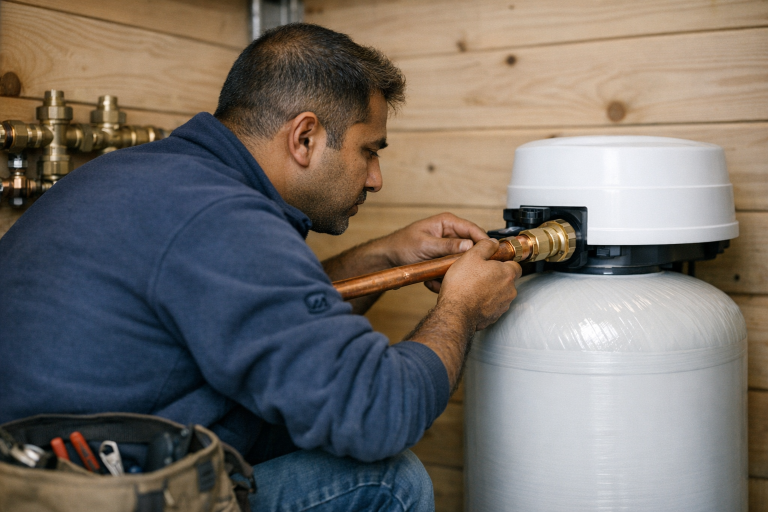
Drain the pressure tank, put the softener in bypass and drain its brine tank if it lives anywhere unheated. Softener control heads are one of the most commonly frozen and cracked components we replace on seasonal properties.
4. If you’d rather keep the cottage warm all winter
Plenty of Orillia and Lefroy owners now heat through the winter because they use the place. That’s a legitimate strategy, but it converts your freeze risk into an equipment failure and power outage risk. Heat only protects pipes while it is running.
Three things make the heated approach actually work. A remote-reading temperature sensor that texts you when the interior drops below a set point. Self-regulating heat trace on the identified vulnerable runs, installed per the manufacturer’s instructions with proper insulation over top. And an automatic shutoff device on the main.
On the shutoff, the Moen Flo is the one we install most on seasonal properties because it does two jobs at once: it detects the pressure signature of a leak and closes the valve itself, and it flags the slow drip you’d never notice from Newmarket or Aurora. Typical supply-and-install for a smart shutoff in this region lands in the $800 to $1,400 range depending on how accessible the main is. Compare that to drying out a cottage after four months of unattended flow.
5. The insulation mistake we see constantly
Foam pipe sleeve is not a heater. It slows heat transfer in both directions. If you wrap a pipe in an unheated crawlspace and leave the cold air path open, you have insulated that pipe from whatever residual warmth was reaching it.
The correct order is: seal the air leak, insulate the building envelope on the cold side of the pipe, and only then sleeve the pipe itself. For a crawlspace under an Orillia cottage that means closing vents for the season, sealing the rim joist, and getting insulation between the pipe and the outdoors – not between the pipe and the house.
6. What repeat-freeze damage costs when you keep patching it
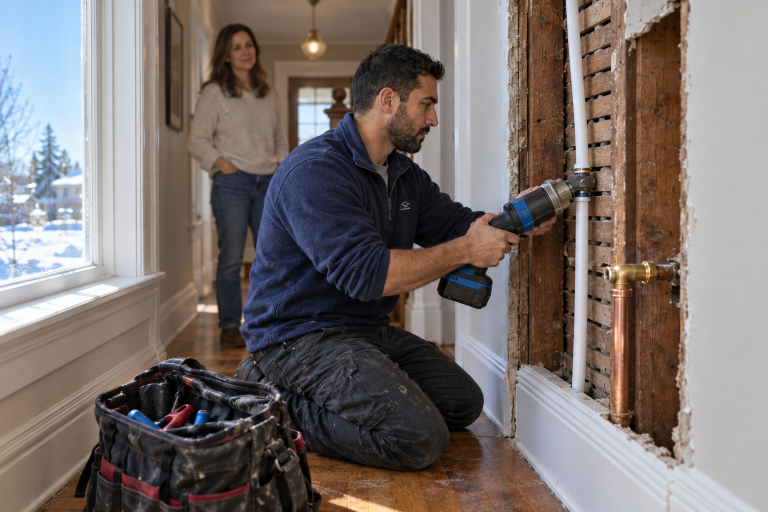
A pipe that has frozen once has usually been stretched. Copper work-hardens and splits at the same spot again. Older polybutylene and early PEX fittings in seasonal cottages fail at the crimp. If you’ve had a freeze in a run and you patched a single section, the rest of that run is now a known weak point.
| Approach | Typical regional cost | Protects against | Fails when |
|---|---|---|---|
| Full professional winterization, annual | ~$250 – $450 small cottage | Every freeze scenario, power outage included | Someone turns the water on for a weekend and leaves |
| Heat trace on identified runs | Varies by run length; budget several hundred | One or two known cold spots | The power goes out, or a different run freezes |
| Air sealing plus envelope insulation | Trade-dependent, one-time | The root cause of most freezes | Extended deep cold with no interior heat at all |
| Moen Flo smart shutoff | ~$800 – $1,400 supplied and installed | Damage volume, not the freeze itself | Nothing, but it doesn’t stop the pipe splitting |
| “We leave a tap dripping” | Free | Marginal cold on a short run | Real Simcoe County cold. Do not rely on this. |
A Related Question We Often Hear
Yes. A pipe that froze and thawed without splitting has still been stressed, and the fitting joints on that run are now suspect. We recommend a pressure check on the affected section and, on copper, a close look for bulging or a slight ovality where the ice plug sat. More importantly: the freeze told you exactly where your cold spot is. That information is worth more than the repair. Fix the air path this fall, before the snow flies.
When the Answer Is Different
The prevention plan for frozen cottage pipes in Orillia changes meaningfully depending on your setup. Here are the exceptions where the standard advice above doesn’t apply cleanly.
You’re on a drilled well with an outdoor pitless adapter
Well systems around Orillia, Ramara and rural Oro-Medonte add a layer. The buried line from the well to the house sits below frost depth and is usually fine, but the run from where it enters the building to the pressure tank often is not. Drain the pressure tank, and if the tank lives in a pumphouse or unheated utility room, that room needs either heat or a full seasonal drain-down every year. A cracked pressure tank or a frozen pump control is a spring-opening surprise nobody enjoys.
You have a tankless water heater
Rinnai and Navien tankless units have built-in freeze protection that only works while the unit has power. Lose hydro in a January storm at a seasonal Orillia cottage and that protection is gone. If the cottage sits empty, drain the tankless heat exchanger per the manufacturer’s winterization procedure rather than trusting the electronics.
And a related caution: we’ve been called out to plenty of cheap box-store import tankless units that error out and turn out to have parts nobody in Ontario stocks. We recommend Rinnai or Navien from day one for exactly this reason – a seasonal property is the worst possible place to own an orphaned appliance.
You have a septic system and a sump pump
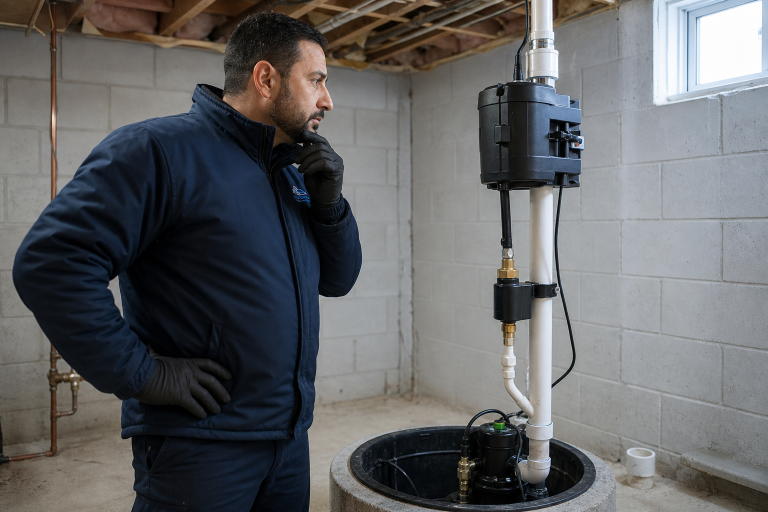
Seasonal Orillia and Cookstown properties on septic need the drainage side considered too. A sump pump discharge line that runs above grade will freeze solid, and then the pump runs against a blocked line during the spring melt and burns out. Either extend the discharge below frost with proper drainage, or pull and store the discharge extension over winter. Test the sump pump before you leave in the fall – spring melt around Lake Simcoe and Couchiching arrives fast.
Your cottage is rented out or used by family in winter
This is the highest-risk category we deal with, and it’s growing across the Orillia area. A short-term guest turns the heat down to save you money, or opens a window, or leaves the crawlspace hatch open. You cannot drain a rented property, so you must monitor it. Temperature sensor, smart shutoff, and a laminated card by the thermostat telling guests the minimum setting is non-negotiable. A drained property is safe. A rented one is only as safe as the last person who left.
Wells add the pressure tank and pumphouse to your drain list. Rinnai and Navien tankless freeze protection dies with the power. Sump discharge lines freeze above grade and kill the pump in spring. Rented cottages cannot be drained, so they must be monitored with a temperature sensor and an automatic shutoff.
Frequently Asked Questions
What temperature should I leave an Orillia cottage set at over winter?
An Orillia cottage that stays on water over winter should be held well above freezing throughout, not just at the thermostat. Most insurers and manufacturers point to a minimum around 13°C to 15°C as a practical floor, because the thermostat in the living room reads much warmer than the crawlspace under the kitchen. Open interior doors and vanity cabinet doors so heated air reaches pipes on exterior walls, and confirm your specific insurance policy’s stated minimum – many require it in writing.
Can I thaw a frozen pipe myself at an Orillia cottage?
You can thaw an exposed frozen pipe yourself with a hair dryer or a heat gun on low, working from the tap end back toward the frozen section with the faucet open. Never use an open flame, a propane torch, or a blowtorch on a pipe inside a wood-framed cottage – that is a well-documented cause of structural fires. If the pipe is inside a wall or you cannot see the whole run, call a licensed plumber; 24/7 emergency service across Orillia, Barrie and Innisfil exists exactly for this.
Does leaving a faucet dripping actually prevent frozen cottage pipes?
A dripping faucet relieves pressure and helps marginally on short runs during a brief cold snap, but it is not a prevention strategy for a Simcoe County winter. It does nothing for a pipe with genuine outside air blowing across it, and it does nothing at all if the cottage loses power and heat. Use it as a stopgap during an unexpected freeze warning, never as your annual plan.
When should I book winterization for a seasonal property in Simcoe County?
Book seasonal winterization for October, before the first hard frost hits Orillia and the northern GTA. The last two weeks of October and the first week of November are the busiest window of the year for every plumber from Newmarket to Orillia, and waiting until a cold-weather warning is issued means competing with everyone else who waited. Typical Simcoe County winterization on a small cottage runs roughly $250 to $450, and it takes a couple of hours when it’s scheduled rather than rushed.
Sources
- Orillia-area historical temperature and frost data supporting the March and April freeze risk window – Environment and Climate Change Canada, Historical Climate Data
- Frozen and burst pipe prevention guidance for seasonal and unoccupied properties – Insurance Bureau of Canada
- Smart water shutoff detection and automatic valve closure function – Moen Flo Smart Water Monitor
- Tankless unit freeze protection requires continuous electrical power – Rinnai America, Product Support
Allain Plumbing
Have a similar question about your cottage? We’re owner-operated, licensed and insured, and we winterize seasonal properties from Innisfil and Alcona north to Orillia. Upfront pricing, no guessing. Professional service available 24/7.
Book Your Orillia Cottage Winterization Before First Frost →
🎧 Listen to article
- A Customer Asked: “Why Is My Sump Pump Running Every Few Minutes in My Alcona Home?” What We Usually Find
- Inside a Drain Camera Inspection in Barrie’s West End: What a Typical Aging-Line Job Looks Like, Start to Fini
- Drain Snaking vs Hydro-Jetting: Which Method Actually Clears Bradford and Cookstown Drain Clogs for Good