
Sump Pump Battery Backup vs Water-Powered Backup: Which System Actually Protects an Alliston Basement During a Power Outage
Sump Pump Battery Backup vs Water-Powered Backup in a Power Outage: What Actually Protects an Alliston Basement
Published September 1, 2026 · Updated September 1, 2026
Sump pump battery backup vs water-powered backup during a power outage in Alliston comes down to one question we ask before anything else: is the house on municipal water or on a drilled well? On a well, a water-powered backup pump is dead weight, because your well pump needs the same hydro that just went out. On municipal water in town, a water-powered unit can run indefinitely while a battery is counting down its last amp-hours.
- A water-powered backup sump pump requires pressurized municipal water, so it will not function on a rural Alliston, Cookstown or Everett-side property served by a private well, because the well pump is electric.
- A battery backup sump pump such as a Zoeller Aquanot or Liberty 442 runs off a deep-cycle battery that most manufacturers ask you to replace every 3 to 5 years, and its runtime is measured in hours of pumping, not days.
- Water-powered backups tie directly into the potable supply, which means a backflow preventer and municipal approval are part of the job. Some Ontario municipalities restrict or prohibit them, so confirm with your town before buying hardware.
- The failure we are called out for most is not the backup pump at all: it is a seized primary pump or a stuck check valve that nobody tested between spring thaw and the next freezing-rain outage.
- A generator plus a properly sized primary pump is the only setup that also keeps the furnace, the fridge and, on a well, the pressure tank alive during a multi-day Simcoe County outage.
The short answer for Alliston power outages
Side-by-side comparison table
Option 1: Battery backup sump pump
Option 2: Water-powered backup sump pump
Option 3: Generator plus a better primary pump
When to choose which
Our verdict
Our take after years of pulling pumps out of Simcoe County basements
FAQ
Sump Pump Battery Backup vs Water-Powered Backup: The Short Answer for an Alliston Power Outage
If you are an Alliston homeowner with a finished basement, a drilled well and a driveway that ices over every February, stop reading the American product reviews. Most of them assume city water at the curb. That assumption is what breaks the water-powered option across half of New Tecumseth, Adjala-Tosorontio and the rural pockets between Cookstown and Angus.
Here is the split. On a private well, buy a battery backup, and think seriously about a generator. On municipal water inside Alliston or Bradford, a water-powered backup gives you something a battery physically cannot: unlimited runtime as long as the water mains hold pressure, which they usually do because municipal systems run on towers and standby power.
The outages that flood basements around here are not the ten-minute blinks. They are the freezing-rain events where a spring-loaded ice load takes a line down and crews are working through the night across Simcoe County, and it happens to be the same week the frost is coming out of the ground and the water table is at its highest. Power out, water table up. That is the combination.
“Almost nobody asks the right first question. It is not which backup pump is better, it is where your water comes from when the hydro is off. Ask a rural Alliston homeowner to flush a toilet twice during an outage and they find out fast that a well is not a water source, it is a machine.”— Matthew Allain, Licensed plumber and owner, Allain Plumbing and Drains
Battery Backup vs Water-Powered Backup vs Generator: Side by Side
| Attribute | Battery backup pump | Water-powered backup pump | Generator + primary pump |
|---|---|---|---|
| Power source | Deep-cycle battery, charged by an onboard charger | Pressurized municipal water only | Gasoline, propane or natural gas |
| Works on a private well | Yes | No, the well pump is electric | Yes, and it also runs the well pump |
| Runtime in an outage | Hours of actual pumping, then it is finished | Indefinite while the water main holds pressure | As long as you have fuel |
| Ongoing maintenance | Battery replacement every 3 to 5 years, terminals checked yearly | Screen and backflow device inspection, no battery to age out | Fuel, oil, monthly exercise cycle |
| Ongoing cost pattern | A replacement battery on a cycle you will forget | Metered water consumed every time it runs | Fuel plus annual service |
| Approvals | Standard install, dedicated discharge or shared with check valve | Backflow prevention required, municipal rules vary and some restrict them | Electrical permit and transfer switch for anything hardwired |
| Best fit | Well-served rural homes, seasonal properties, anywhere off municipal water | In-town Alliston, Bradford, Newmarket and Aurora homes on city water | Finished basements where an outage also threatens heat and the well |
Option 1: The Battery Backup Sump Pump
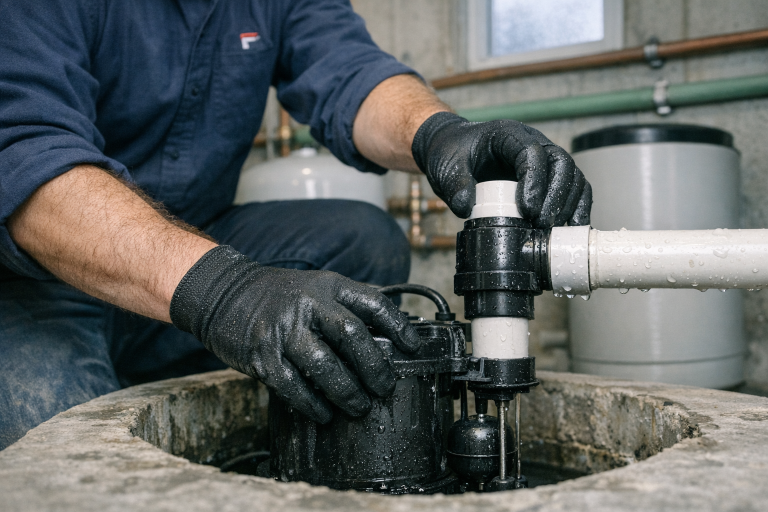
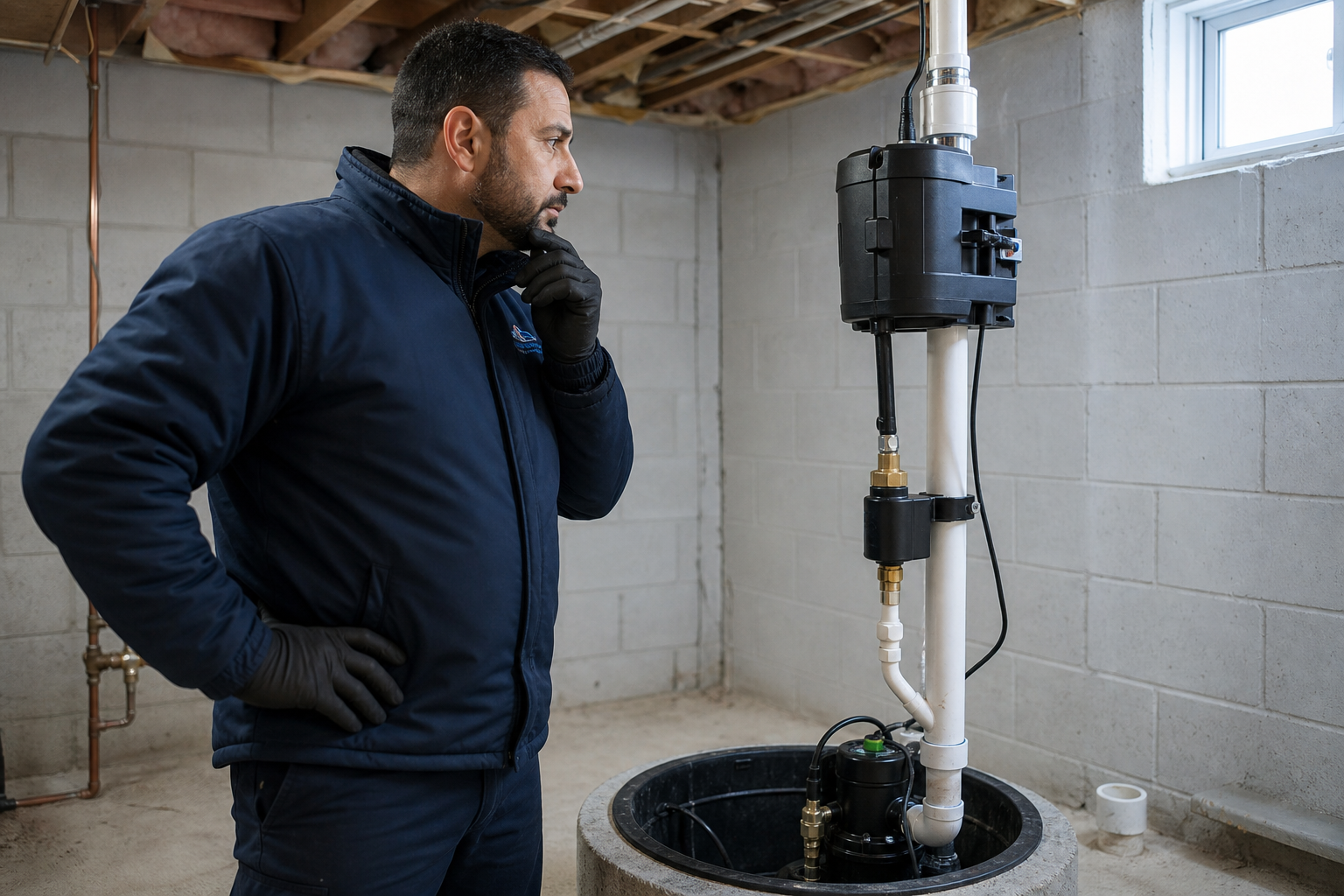
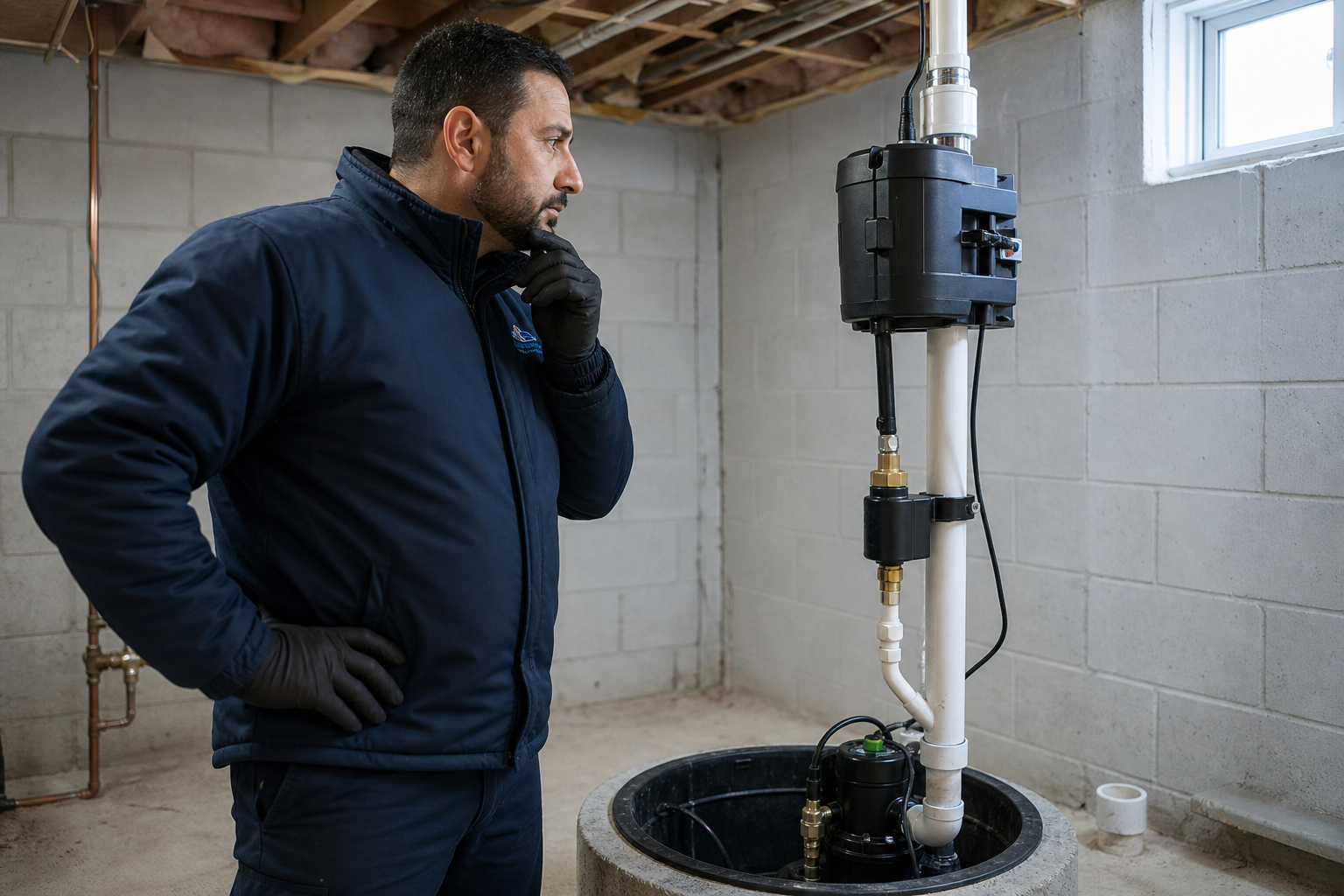
A battery backup sump pump is a second pump mounted in or beside the sump pit, wired to a charger and a deep-cycle battery, and set to start when the primary pump stops keeping up or loses power. Zoeller’s Aquanot line, Liberty Pumps’ 442 series and the Basement Watchdog systems are the units we see most often in Simcoe County basements. They are the default answer for a reason: they do not care where your water comes from.
The weakness is arithmetic. A battery holds a fixed amount of energy, and a pump that cycles hard during spring melt drains it faster than the box’s runtime chart suggests, because those charts assume a light duty cycle. In a long ice-storm outage with a high water table, you can absolutely watch a healthy battery run out before the lights come back.
The second weakness is human. Batteries age quietly. Most manufacturers want them replaced every 3 to 5 years, and the alarm that tells you the battery is weak is exactly the alarm homeowners silence and forget. We have opened plenty of backup boxes to find a battery with corrosion crusted white on the terminals and a charger that gave up two winters ago.
A battery backup sump pump works anywhere, including on a well, and installs in an afternoon in most Alliston basements. Its limit is runtime: hours of hard pumping, not days. Budget for a battery replacement every 3 to 5 years and test the system before spring thaw, not during it.
Option 2: The Water-Powered Backup Sump Pump
A water-powered backup sump pump uses municipal water pressure through a venturi to lift water out of the pit. There is no motor, no battery and no electricity involved. Liberty Pumps’ SumpJet and Zoeller’s water-powered models are the common ones. On a house connected to a town water system, this is the only backup that will still be pumping on hour thirty of an outage.
Three honest caveats. First, it consumes treated, metered water every second it runs, and manufacturers rate these units by how much sump water they eject per unit of supply water used, a ratio that drops as your incoming pressure drops. Second, it must be installed with proper backflow protection, because you are connecting a potable line to a pit that can hold groundwater, silt and whatever came in through the weeping tile. Third, municipal rules differ, and some Ontario municipalities restrict or prohibit these units outright. Confirm with your town and have a licensed plumber pull the permit if one is required.
And then the disqualifier for a huge slice of our service area. No municipal water, no water-powered pump. Rural properties around Alliston, Cookstown, Angus and the concession roads north toward Orillia run on wells, and a submersible well pump is an electric motor. Once the pressure tank bleeds down, you have nothing. We say this plainly because the internet does not.
Option 3: A Generator and a Primary Pump That Deserves It
A generator paired with a healthy primary sump pump is the option nobody comparing backup pumps bothers to list, and for a rural Alliston or Everett-side property it is often the right one. Power the house and you power the sump pump, the well pump, the furnace and the fridge at the same time. A backup pump only ever solves one of those problems.
The catch is that a generator needs a human. Somebody has to be home, awake and willing to go outside in freezing rain to start a portable unit and hook it up through a proper transfer switch. A standby unit with an automatic transfer switch removes that problem, and an electrician handles that side of the work. Seasonal and cottage owners around Lefroy or up toward Orillia rarely have anyone at the property in March, which is exactly why we put battery backups in those houses instead.
One more piece of honesty. If your primary pump is a cheap import with a plastic-bodied switch and no parts availability in Ontario, no backup strategy fixes that. It is the same pattern we warn about with cheap box-store tankless water heaters, where the unit errors out and the parts are not stocked anywhere in the country. Buy the pump that a Canadian supply house actually carries parts for.
When to Choose Which
Choose a battery backup if you are on a well
Rural properties around Alliston, Cookstown, Angus, Midhurst and the lines north to Orillia. Also the correct pick for any seasonal or cottage property where nobody will be there to start a generator.
Choose a water-powered backup if you are on municipal water and away often
In-town Alliston, Bradford, Alcona, Newmarket and Aurora homes, especially for the snowbird or the family that travels in March. No battery to die while you are gone. Confirm your municipality permits it first.
Choose a generator if the outage threatens more than the basement
Finished basement, well pump, furnace and a family staying put. This is the setup for the year-round rural homeowner who has already lost a weekend to a January ice storm.
Choose belt and suspenders if the basement is finished and occupied
City water plus a water-powered backup plus a battery unit is not overkill for a finished basement with a bedroom in it. The two systems fail in completely different ways, which is the point.
Our Verdict
For rural Alliston, the verdict on sump pump battery backup vs water-powered backup during a power outage is not close: battery backup wins, because the water-powered unit cannot function without an electric well pump feeding it. Pair it with a generator if anyone is home during the storm.
For in-town Alliston and the serviced subdivisions in Bradford, Alcona and Newmarket, the water-powered backup wins on the one metric that matters most in a long outage: it never runs out. If your municipality allows it and the install includes proper backflow protection, it is the lower-maintenance choice over a decade.
Neither one wins if the primary pump is junk or the discharge line freezes solid at the exterior wall. That is the part we would rather talk to you about first. A backup system that discharges into a plugged, ice-filled pipe is a backup system that pumps water straight back into your pit.
Our Take After Years of Pulling Pumps Out of Simcoe County Basements
Homeowners overweigh the pump and underweigh the plumbing around it. The check valve, the discharge line, the pit lid, the float clearance, the exterior termination that gets buried under a snowbank in January: those are what we find when we open up a flooded basement. The pump itself is usually the least interesting part of the failure.
Honestly, the thing that changed how we talk about backups was seeing how often the primary pump had already failed silently, sometimes weeks earlier, and the backup had been carrying the whole house without anyone knowing. That is a house one outage away from a wrecked basement. Two pumps only help if you know both are alive. Lift the lid twice a year and pour a bucket in. Listen for the clunk of the check valve seating. That is the whole test.
Same logic applies elsewhere in the house, and it is the pattern behind most of our emergency calls. A slow toilet refill is a fill valve, a small part, an easy afternoon. Ignore it long enough and it works the tank seal loose and becomes a tank-to-bowl gasket job. Pour drain cleaner repeatedly into a slow drain and the lye chews the rubber gaskets in the trap, turning a clog into a trap replacement. Small maintenance, ignored, always gets expensive. A weak backup battery is exactly that story with a wet basement at the end of it. A smart water monitor like a Moen Flo will catch a supply-side leak, but it will not tell you your sump pit is filling, so do not confuse the two.
Frequently Asked Questions
Will a water-powered backup sump pump work if my Alliston house is on a well?
No. A water-powered backup sump pump needs continuous pressurized water, and a private well is pressurized by an electric submersible or jet pump. During a power outage you have only the small reserve in the pressure tank, which is gone in minutes. Rural properties around Alliston, Cookstown and Angus should install a battery backup instead.
How long does a battery backup sump pump actually run during a power outage?
A battery backup sump pump runs for hours of actual pumping, not days, and the real number depends on battery capacity, water inflow and how hard the pump cycles. Spring thaw in Simcoe County produces a much heavier duty cycle than the runtime charts assume. Manufacturers such as Zoeller and Liberty Pumps generally recommend replacing the deep-cycle battery every 3 to 5 years.
Are water-powered backup sump pumps allowed in Ontario?
Water-powered backup sump pumps connect to the potable supply, so they require backflow protection and are governed by local municipal water bylaws as well as the Ontario Building Code. Rules differ by municipality and some restrict or prohibit them. Confirm with your town, in Alliston that means New Tecumseth, and have a licensed plumber verify the install and any permit requirement.
Can I install a backup sump pump myself?
A battery backup is within reach for a confident DIYer, but a water-powered unit is not, because it is a cross-connection to your drinking water. We receive two to three emergency calls a month across Innisfil, Barrie and Bradford from half-finished DIY valve work where the valve broke and the homeowner could not stop the flow. Discharge routing and freeze protection also need to be right, or the backup pumps into a blocked line.
Sources
- Building and plumbing requirements in Ontario, including cross-connection and backflow provisions — Ontario’s Building Code, Government of Ontario
- Water-powered backup sump pump product specifications and installation requirements — Liberty Pumps
- Battery backup sump pump systems and battery maintenance guidance — Zoeller Pump Company
- Municipal water bylaws and permit requirements for Alliston properties — Town of New Tecumseth
If your basement has been dry for ten years, that is not a plan, that is a streak. We handle sump pump installation and basement water, drain camera inspection when the weeping tile is suspect, well pump and water quality work on rural properties, and 24/7 emergency plumbing from Innisfil and Alcona through Alliston, Angus, Bradford and north to Orillia.
Allain Plumbing
Book a Sump Pump Backup Assessment for Your Alliston Basement →