

Inside a Drain Camera Inspection on a Newmarket Property with Mature Trees: What Root Intrusion Typically Looks Like on the Monitor
Drain Camera Inspection Root Intrusion Older Newmarket Property Sewer Line: What the Monitor Actually Shows
Published September 6, 2026 · Updated September 6, 2026
Drain camera inspection root intrusion older Newmarket property sewer line work almost always ends at the same picture on the screen: a joint in clay or old cast iron with fine white roots hanging into the flow like wet hair. Not a blockage of grease. Not a collapsed pipe. A hair-thin feeder root that found a hairline gap at a joint years ago, drank, and got greedy.
- Root intrusion enters at joints, not through solid pipe walls. On the monitor it appears as white or tan hair strands at a visible seam, usually in clay tile or cast iron laterals on older Newmarket, Aurora and Barrie streets with mature maples and silver maples out front.
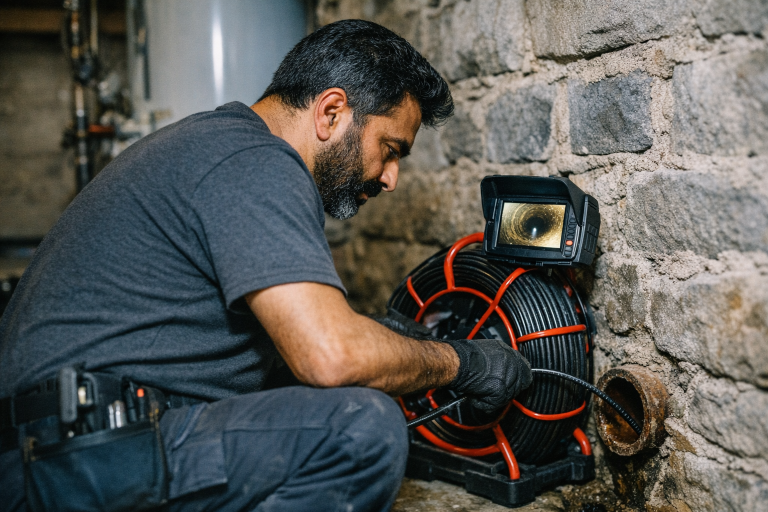
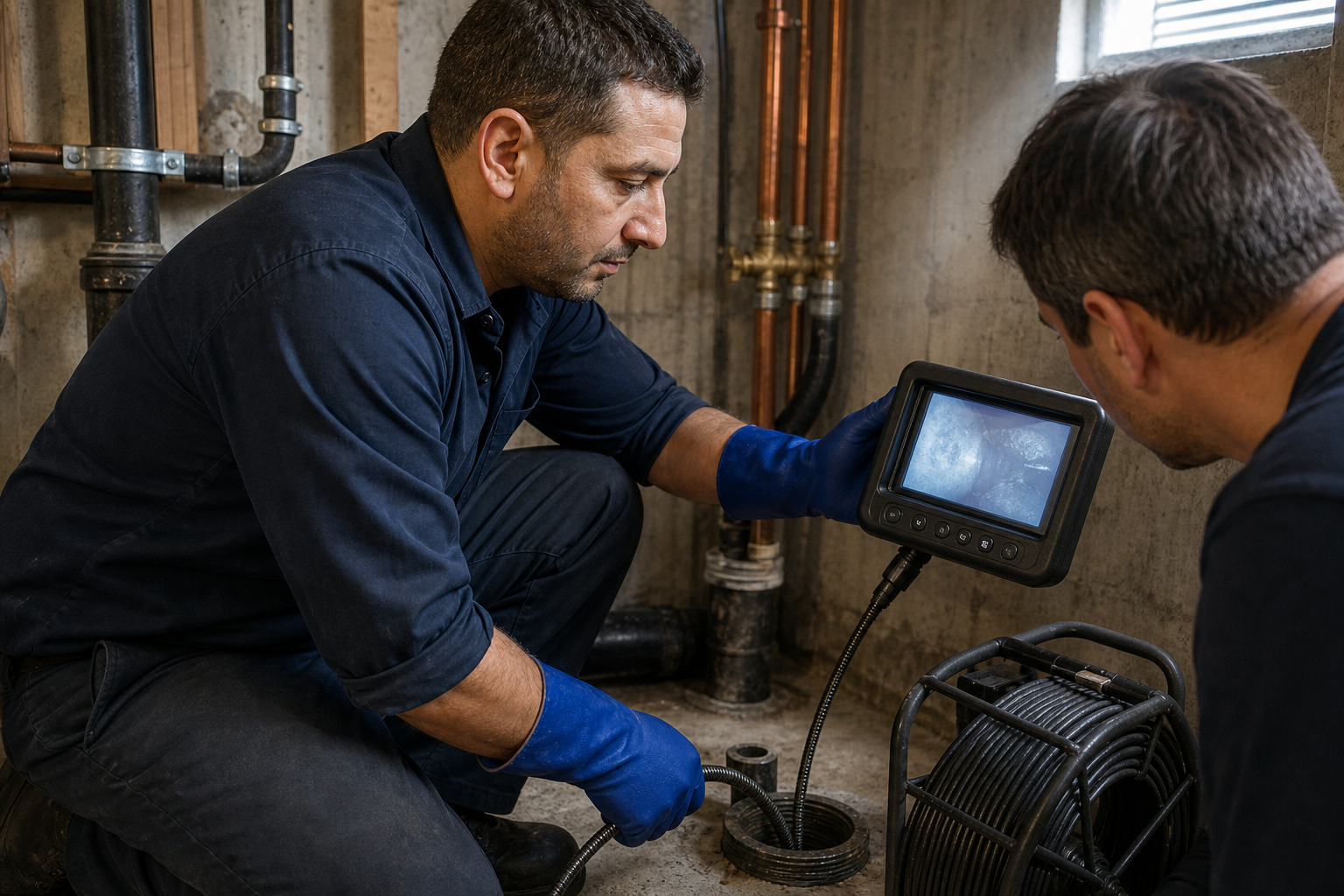
- A drain camera inspection uses a locating sonde in the camera head, so we can mark the exact spot on the lawn or driveway with a locator before anyone talks about digging.
- Repeat backups in the same fixture on the lowest level (floor drain, basement toilet, laundry standpipe) are the classic root signature, and they typically return on a seasonal rhythm rather than randomly.
- Chemical drain cleaner does not fix roots and repeated use eats rubber gaskets in traps, turning a small clog into a trap replacement job. We see that mistake constantly.
- Allain Plumbing runs camera inspections across twelve communities: Innisfil, Alcona, Stroud, Lefroy, Barrie, Painswick, Midhurst, Bradford, Cookstown, Angus, Alliston, Newmarket, Aurora and north to Orillia.
- Cutting roots restores flow; it does not close the joint. A cut line buys time on a predictable cycle, while a spot repair or liner at the failed joint is what ends the cycle.
What We Found: Drain Camera Inspection Root Intrusion in an Older Newmarket Property Sewer Line
On a typical older Newmarket property, the sewer lateral leaves the house through the basement wall, runs under the front lawn, and ties into the municipal main under the street. If you are a homeowner on one of the pre-1970s streets in Newmarket or Aurora with a canopy of mature maples over the road, that lateral is very likely clay tile or cast iron, joined every few feet, and every one of those joints is a potential doorway.
The first thing we do is not push the camera. It is find a clean access point, usually the main cleanout in the basement, and confirm the line will accept a cable without us shoving a camera head into standing sewage where the lens is useless. If the line is full, we clear enough to get a picture. You cannot inspect what you cannot see.
Then the picture arrives. The first stretch of pipe looks fine: dull, uniform, a thin trickle of water down the invert. A joint passes. Another joint passes. Then the wall changes. There is a dark horizontal seam, and hanging off the top of that seam, drifting slightly in the current, are pale hairlike strands. That is the moment the homeowner standing behind us goes quiet. Roots do not look like a root ball on a monitor. They look like a mop head, or a fine white beard, catching every piece of toilet paper that floats past.
“People expect roots to look like a tree trunk in the pipe. They almost never do at the start. It is a fine white fringe at one joint, and the paper it catches is what actually blocks you. By the time it looks like a trunk on the screen, we are talking about excavation, not cleaning.”— Matthew Allain, Licensed plumber and owner, Allain Plumbing and Drains
Past the intrusion, we look for the second half of the story, which most people never ask about. Is the pipe holding water on the downstream side, meaning the line has settled? Is there scale or a hairline crack around the same joint? Are there multiple joints with fringe, or one bad one with clean pipe on both sides? One offending joint and clean pipe elsewhere is the best outcome you can get on a root call. Fringe at six joints in a row means the whole lateral is tired.
Reading the Monitor: What Each Image Actually Means
During a drain camera inspection, the homeowner watches the same screen we do. That is the point of the service. Here is the translation we give while the reel is feeding, so nobody has to take our word for what a gray blur means.
| What you see on the monitor | What it usually is | What it usually needs |
|---|---|---|
| Fine white or tan strands at a visible seam, moving with the flow | Early root intrusion at a joint in clay or cast iron | Mechanical cutting now, plus a plan for the joint |
| A dense mat that fills most of the pipe, paper snagged on it | Established root mass, likely years old | Cutting head, then re-camera, then spot repair or lining discussion |
| Camera goes underwater and the picture turns brown | A belly (settled section) or a downstream blockage holding water | Clear first, re-inspect, then evaluate grade |
| Flaky orange-brown shelf along the bottom of the pipe | Scale and tuberculation in aging cast iron | Descaling, not just augering |
| Soil visible through the pipe wall, or the picture drops and tilts | Broken or offset pipe, possible collapse | Locate and excavate the section, no cleaning will fix it |
| Clean, uniform gray or white wall with crisp joints | A healthy line, problem is upstream in the house | Look at fixture drains, traps and venting instead |
Root intrusion on an older Newmarket sewer line shows on the monitor as pale hairlike strands at a pipe joint, not as a solid mass, and paper caught on that fringe is what causes the backup. A camera inspection separates roots from a belly, from scale, and from a broken section, which are four different repairs. If the wall is clean and the joints are crisp, the problem is inside the house.
How We Solved It
This is the sequence on a typical root call, in order, with the actual gear in hand. Nothing here is exotic. The discipline is in doing it in this order instead of skipping to the auger and hoping.
- Get the water down and protect the finished basement. Drop cloths, a wet vac, and containment at the cleanout before anything opens. Sewage on a finished floor is a much bigger problem than the clog.
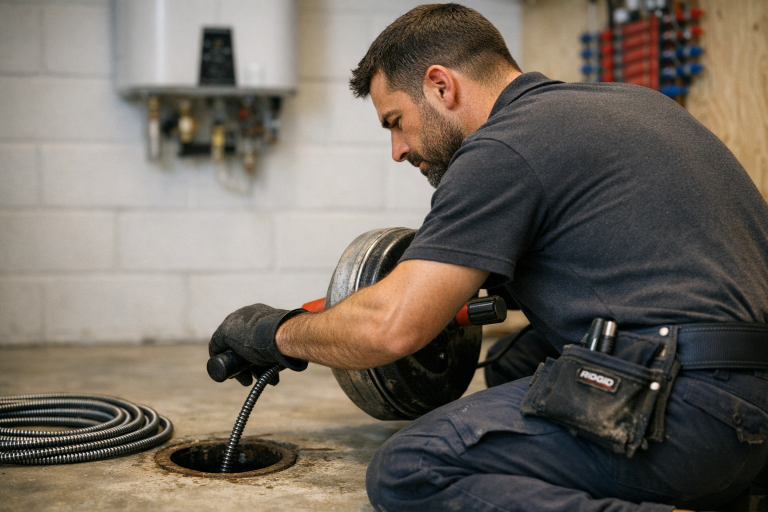
- Open the main cleanout and cable the line first. A sectional or drum machine with a root-cutting head, RIDGID and General Wire style equipment, restores flow so the camera has something to see. Cutting before inspecting is the opposite of what most articles say, but a lens under six inches of sewage shows you nothing.
- Push the color camera on a self-leveling head from the cleanout toward the street. The homeowner watches the monitor live. We call out every joint, every transition, every change in wall texture.
- Stop at the intrusion and mark it above ground. The camera head carries a sonde, and a locator such as a RIDGID NaviTrack picks it up through the soil. We mark the lawn or driveway with paint and note the approximate depth. That mark is what turns a guess into a targeted repair.
- Keep going to the property line. We want to know whether the failed joint sits on the private drain connection or closer to the municipal main, because responsibility differs and the Town of Newmarket and York Region should be contacted if the issue looks like it sits on their side.
- Re-cut with a larger head if the first pass was conservative, then re-camera. The second look confirms the wall behind the roots is intact rather than cracked, and shows whether the pipe holds water once flow is restored.
- Record the footage and hand over a plain-language report. Where the intrusion is, how far from the house, what the pipe material is, and the honest options: a maintenance cutting cycle, an excavated spot repair at the one bad joint, or a full lateral replacement if the line is failing along its length.
One detail we never skip anymore: verifying the cleanout cap and the shutoff situation before we start. We get emergency calls two to three times a month from half-finished DIY work where a valve broke off in someone’s hand and they could not stop the flow. Different service, same lesson. Know where your isolation is before you open anything. Our 24/7 emergency plumbing line exists mostly because of that one gap.
What This Means for Older-Home Owners in Newmarket, Aurora and Simcoe County
If you own a pre-1970s house on a treed street in Newmarket, Aurora, Bradford, Alliston or an older pocket of Barrie, and your basement drain has backed up more than once in two years, you are not dealing with bad luck. You are dealing with a repeating mechanical cause, and a drain camera inspection for root intrusion in an older sewer line is how you name it. This is for homeowners who have already had the line snaked at least once, not for someone whose kitchen sink is slow for the first time.
The second lesson is about timing. Roots chase moisture, and in our region the pattern homeowners notice most is trouble in the dry stretch of late summer and again around freeze-up and thaw, when ground movement works at old clay joints. Seasonal and cottage property owners around Lefroy, Innisfil and Orillia have an extra wrinkle: an intermittent backup can sit undiscovered for months because nobody is there to see it. Camera the line before you close up for the season, not after you find the mess in May.
Third, and this is the one that costs people the most money: a camera inspection is cheap insurance before you finish a basement, before you buy an older house, and before you commit to any excavation. Digging in the wrong place is the single most expensive mistake in this trade. We would rather spend part of a morning with the reel than watch someone open a trench on a hunch. If you are also fighting basement water and sump pump issues, knowing whether the sewer lateral is intact changes the whole diagnosis.
Why Roots Come Back, and What Actually Slows Them Down
Root intrusion in a sewer lateral comes back because cutting removes the roots inside the pipe and does nothing to the gap they came through. The tree is still there. The joint is still open. The warm, nutrient-rich air escaping that joint is still the most attractive thing in that soil. Cutting buys a predictable interval, and for a homeowner who is not ready to excavate, a scheduled cutting cycle before the wet season is a legitimate strategy. Just call it what it is: maintenance, not repair.
What does not work is the aisle of chemicals at the hardware store. Caustic drain cleaners will not touch an established root mat in a buried lateral, and repeated dosing is genuinely destructive: the lye attacks rubber gaskets inside traps and fittings, and we have converted plenty of “small clog” calls into trap replacement calls because of it. Foaming root treatments have a narrow, real role as a follow-up after mechanical cutting, but if you are on a septic system, which plenty of our rural customers in Cookstown, Angus and Midhurst are, do not put copper sulfate style products down the line without asking first. You can damage the biology that makes the septic system work.
The permanent fixes are structural. A spot repair excavates and replaces the one failed section with modern PVC or ABS and proper couplings. A cured-in-place liner seals the interior of the existing pipe, which closes the joints roots use, though it needs a host pipe in decent enough shape to line. A full lateral replacement makes sense when the camera shows fringe at joint after joint and a line that has settled. Which one is right depends on what the footage shows, the depth, and what is on top of the line, a lawn versus an interlock driveway versus a mature tree you are not willing to lose.
Our Take After Years of Running Cameras Down Sewer Lines Here
Homeowners overweigh the tree. The question we get most is “should I cut down the maple,” and honestly, cutting the tree rarely solves it fast. Roots from a neighbor’s tree, or from a boulevard tree the Town owns, travel farther than people expect, and a dying stump can keep feeding into a joint for a long time. The joint is the problem. The tree is just the opportunist. We would rather see the joint closed than the canopy gone.
What surprised us over time is how often the camera clears a homeowner of the thing they were most afraid of. People brace for a collapsed line and a trench across the front lawn, and what shows up is one joint with a fringe on it and clean clay on either side. That is a manageable day. The reverse also happens, and that is why we run the camera all the way to the connection instead of stopping at the first thing we find. Stopping early is how a second problem gets missed and a repair fails.
The one thing we would tell a friend buying an older place in Newmarket or Aurora: get the lateral scoped before you close, the same way you would want the roof looked at. It is the least glamorous inspection you can buy and the only one that shows you a buried asset you cannot otherwise see. Ignoring small signals is a habit that gets expensive across this whole trade. It is the same pattern as ignoring a toilet that refills slowly for months, a simple fill valve issue that eventually works the tank seal loose and becomes a tank-to-bowl gasket job. Small signal, patient damage, avoidable bill. Our drain cleaning and clog removal and drain camera inspection services are built around catching those signals early.
Frequently Asked Questions
How do I know it is roots and not grease or flushable wipes?
Roots versus grease is decided on the monitor, not by guessing. Root intrusion appears as pale hairlike strands anchored at a pipe joint, while grease appears as a smooth beige coating on the pipe wall with no seam involved, and wipes appear as a gray rag-like clump that moves. In older Newmarket and Aurora homes with clay or cast iron laterals and mature street trees, root intrusion at a joint is the pattern we see most.
Can the camera tell you exactly where to dig?
Yes. The camera head carries a sonde transmitter, and a locator such as a RIDGID NaviTrack picks up that signal from the surface, so we mark the spot on the lawn or driveway with paint and note the approximate depth. That mark is what lets an excavation be targeted at one failed joint instead of trenching the length of the front yard. Before any digging, locates for gas, hydro and telecom still have to be arranged.
If roots are on the municipal side, who is responsible?
Responsibility for a sewer lateral usually splits at the property line, with the homeowner responsible for the private drain connection on their property and the municipality responsible for the main. Rules vary by municipality, so Newmarket and Aurora homeowners should confirm directly with the Town and with York Region. Our camera footage showing distance from the cleanout is exactly the evidence that conversation needs.
Will cutting the roots damage an old clay sewer line?
Cutting roots in aged clay tile is done with matched head sizing and judgment, because an oversized cutter in an already cracked pipe can make things worse. That is the reason we re-camera after cutting: the second pass confirms whether the pipe wall behind the root mat is intact or whether the joint has already offset. If the footage shows visible soil or a dropped section, cleaning stops and the conversation moves to repair.
Sources
- Municipal sewer service and private drain connection information for Newmarket homeowners — Town of Newmarket
- Regional water and wastewater responsibility across York Region, including Newmarket and Aurora — The Regional Municipality of York
- Drainage and plumbing requirements referenced in this article should be confirmed against the current code — Ontario’s Building Code
- Sewer inspection camera reels and sonde locating equipment referenced by name — RIDGID
- Service area, camera inspection process and booking — Allain Plumbing
Allain Plumbing
Serving Innisfil, Alcona, Stroud, Barrie, Midhurst, Bradford, Cookstown, Angus, Alliston, Newmarket, Aurora and north to Orillia.
Book a Sewer Camera Inspection and Watch the Monitor With Us →
🎧 Listen to article
- Inside a Drain Camera Inspection in Barrie’s West End: What a Typical Aging-Line Job Looks Like, Start to Fini
- Inside a Burst Pipe Emergency Call in Barrie’s Painswick Neighbourhood: What a Typical Winter Job Looks Like,
- Inside a Water Softener Installation on a Stroud Rural Property: What the Typical Job Involves, Start to Finis
- A Customer Asked: “Our Alcona Well Water Smells Like Rotten Eggs — Is That a Plumbing Problem or a Water Quali
- Drain Snaking vs Hydro-Jetting: Which Method Actually Clears Bradford and Cookstown Drain Clogs for Good