
PEX vs Copper Re-Pipe in a Barrie Century Home: Which Way We Go and Why
Last updated: September 23, 2026
Published September 23, 2026 · Updated September 23, 2026
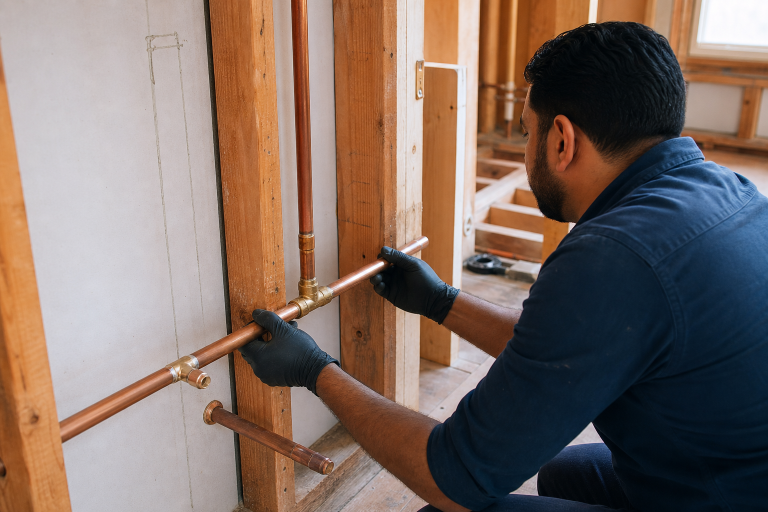
When a homeowner asks us the PEX vs copper repipe Barrie older home whole house question, our answer for most century homes is PEX-A tubing (such as Uponor AquaPEX with expansion fittings) inside the walls, with copper kept for exposed basement runs and the connections at the water heater. Most people assume copper is the upgrade and plastic is the shortcut. In a century home, the reasoning usually runs the other way.
Below, the Allain Plumbing crew compares three real approaches: a full PEX-A re-pipe, a full copper re-pipe (soldered or with Viega ProPress fittings), and the hybrid we lean toward in older houses. Copper still wins some houses outright, and we will tell you which ones.
- PEX-A tubing such as Uponor AquaPEX fishes through century-home plaster walls with far fewer openings than rigid copper, which is why it is our default for finished walls in older Simcoe County homes.
- Copper pipe is the better choice where water lines stay exposed to daylight, heat or rodents, including unfinished farmhouse basements, cottage crawlspaces and light-commercial mechanical rooms.
- Acidic well water on some rural properties around Midhurst, Cookstown and Angus can cause pinhole leaks in copper, so we test the water before choosing the pipe.
- Replacing metal water pipe with PEX can interrupt the home’s electrical bonding path, so a licensed electrical contractor should verify it under Ontario rules overseen by the Electrical Safety Authority (ESA).
- DIY shutoff valve swaps done without isolating the main bring Allain Plumbing 2 to 3 emergency calls per month where the old valve broke off and the homeowner could not stop the water.
- Neither pipe is freeze-proof: PEX-A handles a hard freeze better than copper, but lines in cold exterior walls still need heat, insulation or a drain-down plan through a Simcoe County winter.
- Which re-pipe option wins in an older home?
- PEX-A: strengths and weak spots
- Copper: where it still beats PEX
- The hybrid re-pipe
- What we find inside century-home walls
- How a whole-house re-pipe goes
- Winters, wells and seasonal properties
- When to choose which
- Our Verdict
- Our take after years of re-piping
- FAQ
- Sources
PEX vs copper repipe Barrie older home whole house: which one wins?
PEX-A wins most whole-house re-pipes in century homes, and copper wins wherever the pipe stays exposed, runs hot or sits in daylight. The deciding factors are what the house is built from, where the water comes from and how cold the pipe gets. None of that is about which material is “better” in a showroom.
If you just bought a century home in downtown Barrie or a farmhouse outside Cookstown and the home inspector wrote “galvanized supply lines” in red, this table is the short version. Read the sections after it for the reasons.
| Attribute | PEX-A (expansion fittings) | Copper (soldered or press) | Hybrid |
|---|---|---|---|
| Overall cost | Usually the lowest total: cheaper material, fewer fittings, faster runs | Usually the highest: material and fitting labor both climb | In between: copper only where it earns its place |
| Plaster and wall openings | Smallest: coils fish through old cavities | Largest: rigid lengths need straight access | Small in finished walls, open only where copper is exposed anyway |
| Freeze tolerance | Better: tube stretches before splitting, fittings still vulnerable | Poor: tends to split open when ice forms | PEX goes in the cold exterior walls |
| Acidic (low pH) well water | Not attacked by low pH the way copper is | Pinhole risk; blue-green fixture stains are the warning | Test and treat the water, keep copper runs short |
| Heat, sunlight, rodents | Keep out of UV, metal transition at the heater, protect from chewing | Shrugs off heat and daylight; mice leave it alone | Copper covers the exposed and hot zones |
| Electrical bonding | Breaks any metal bonding path; electrician must verify | Can preserve a metal path; still worth verifying | Electrician checks every metal-to-PEX transition |
| Best fit | Finished century homes, farmhouses on acidic wells | Open basements, shops and restaurants with exposed runs | Most occupied older homes |
You will notice there is no dollar figure in that table. Every PEX vs copper repipe Barrie older home whole house quote we write comes after walking the house, because fixture count, floors and wall access move the number more than the pipe does. Ask us for it in writing.
What is PEX-A like in a whole-house re-pipe of an older home?
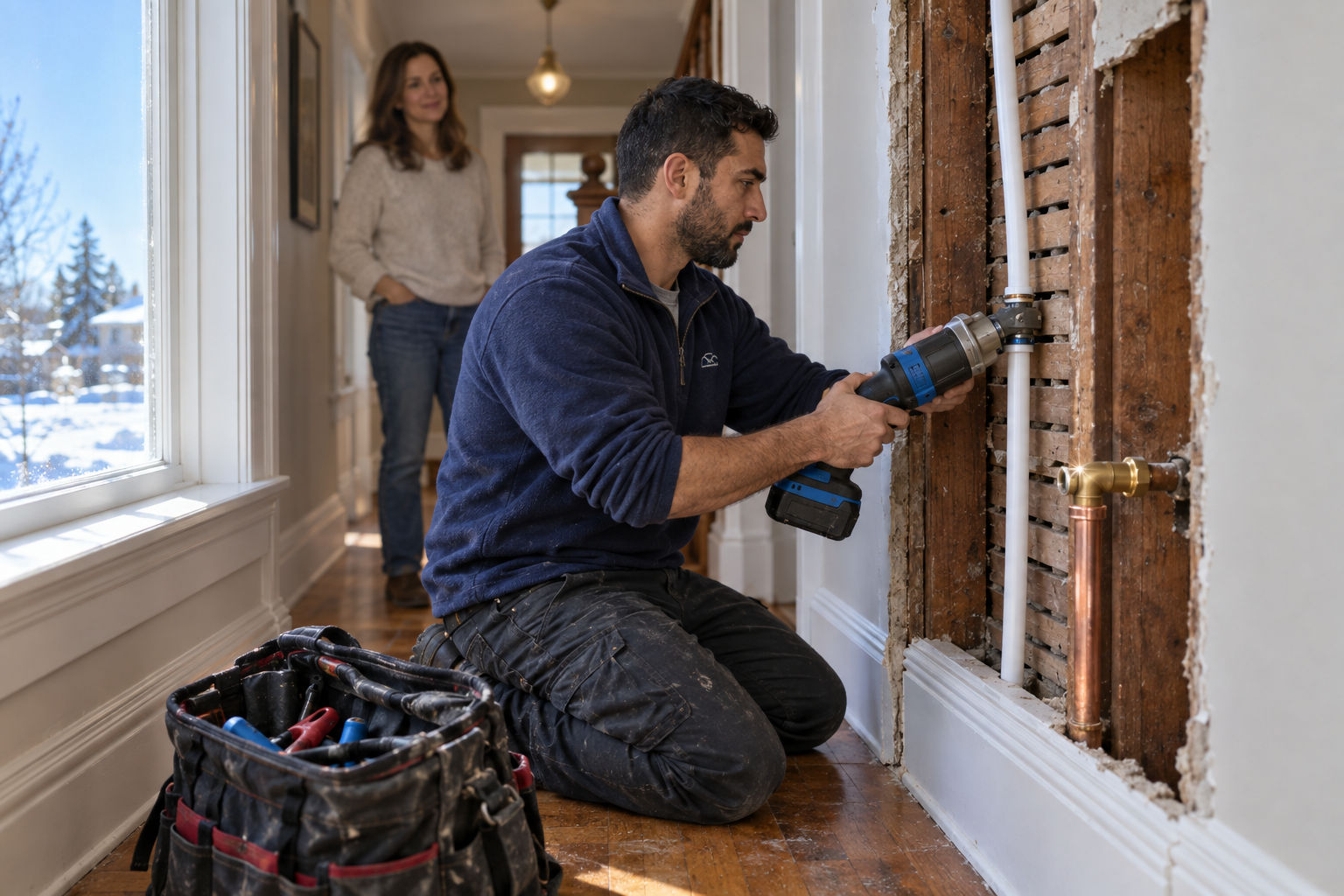
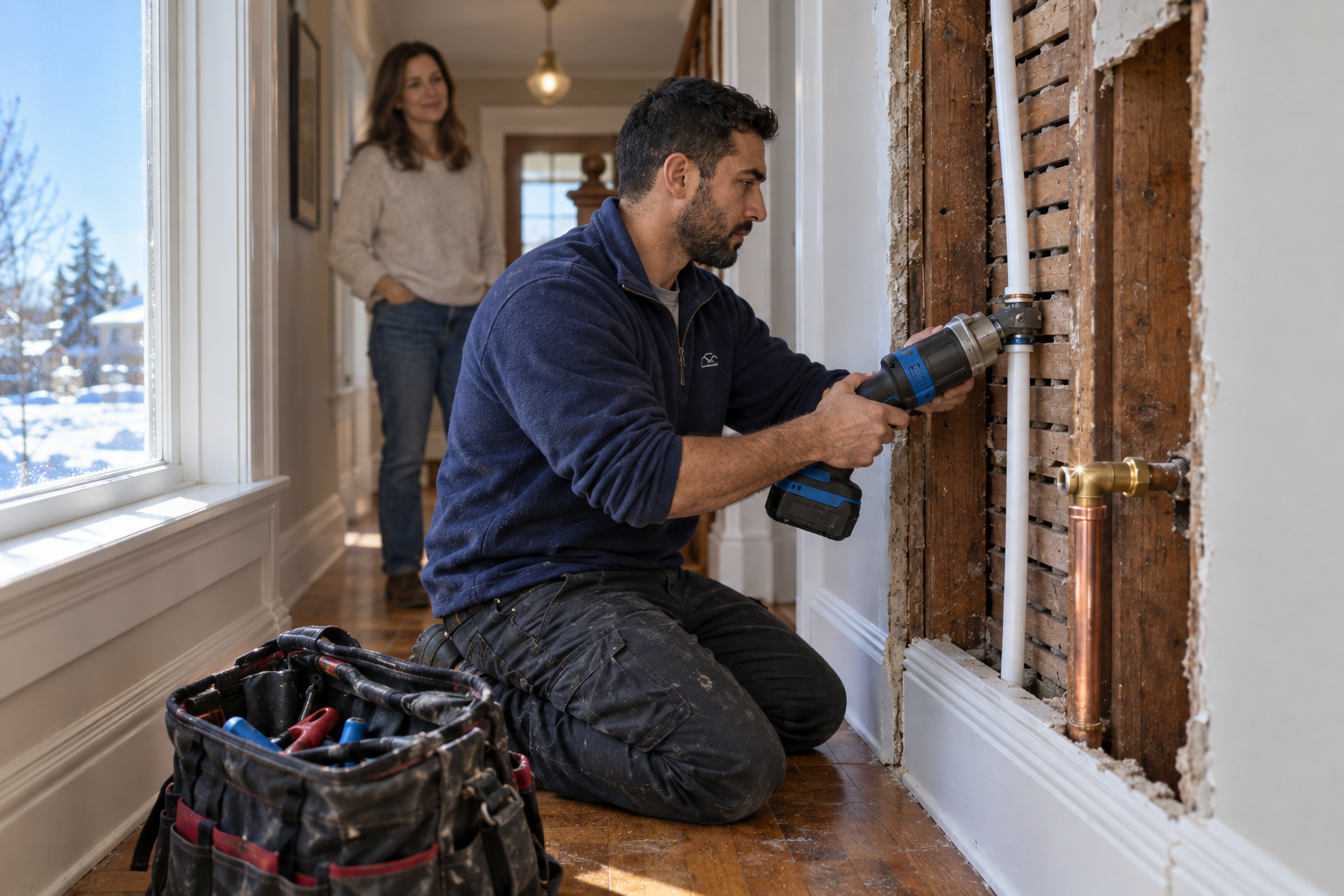
PEX-A is cross-linked polyethylene tubing that bends around framing and fishes up through old wall cavities, which makes it the least destructive way to re-pipe an occupied century home. We can often run a line from the basement to a second-floor bathroom through one closet opening. Horsehair plaster crumbles if you look at it wrong, so every hole we do not cut matters.
Uponor AquaPEX with ProPEX expansion fittings is our usual pick. The tube is expanded, slipped over the fitting and shrinks back tight, and the fitting does not narrow the waterway the way an insert crimp fitting does. Certified PEX-B with crimp rings is also common, especially on box-store shelves, but we prefer the expansion system on a whole house.
The strengths add up fast. Fewer fittings means fewer joints to leak, a home-run manifold can give each fixture its own shutoff in one spot, and in our experience PEX runs quieter than copper when a valve slams shut. It also handles low-pH well water without pitting.
The weak spots are real. PEX breaks down in sunlight, PEX manufacturers’ instructions call for a metal transition and clearance at the water heater, and mice in a farmhouse crawlspace will chew it. Pulling out metal pipe can also disconnect your electrical bonding. Each of those is manageable. None should be ignored.
Where does copper still beat PEX in a century home?
Copper pipe beats PEX anywhere the line will be exposed, hot, sunlit or within reach of rodents. It has decades of track record in Ontario homes, it does not care about daylight, and a mouse has no interest in it. Honestly, the prettiest work we do is still a clean run of copper across a basement ceiling.
Copper also holds its shape, so exposed runs stay straight and supported for decades, which matters in a shop, a restaurant mechanical room or an unfinished basement where someone bumps pipes with a shelf. We use Mueller copper tube and either solder the joints or press them with Viega ProPress.
Press fittings earn their keep in old houses. Soldering means an open flame next to framing that has been drying out for a century, and we take hot work in those walls seriously. You can smell the flux the second the torch hits a joint. With press fittings there is no flame at all.
The downsides are just as clear. Rigid copper needs more wall opened to get it in, the labor and material run higher, it tends to split when it freezes, and acidic well water can eat pinholes through it from the inside. Copper is a great pipe. It is not always the right pipe.
What is a hybrid PEX and copper re-pipe, and why do we lean toward it?
A hybrid re-pipe runs PEX-A through finished walls and ceilings and uses copper for the main entry, the mechanical room and any line that stays exposed. It takes the least destructive route through plaster and the most durable route where pipe can be seen, touched or heated. For most occupied older homes in Simcoe County, it is the approach we recommend first.
The water heater is the clearest example. Whether you have a Bradford White or Rheem tank, or a Rinnai or Navien tankless, we follow both the heater and the PEX manufacturer’s instructions for metal connections and clearance, and we pipe that zone in copper. The exact distances live in those instruction sheets, so we read the one for the heater in front of us.
A re-pipe is also when homeowners think about going tankless. One pattern we see: someone buys the cheapest box-store import tankless, it throws an error code, and the parts are not stocked anywhere nearby. We recommend Rinnai or Navien from day one for exactly that reason.
The hybrid only works if transitions are done right. Every copper-to-PEX joint uses a proper transition fitting, is supported and stays accessible. A mishmash of adapters from three different systems is how a good re-pipe turns into a callback.
What do we usually find inside the walls of an older Barrie home?
Older Barrie homes, especially century houses in the older blocks near Kempenfelt Bay, usually hide a mix of galvanized steel, patched copper and a few decades of DIY repairs. Knowing what is in there shapes the re-pipe more than the brochure does. Here is what we check for on the first walkthrough.
Galvanized steel supply lines
Galvanized steel water pipe corrodes and scales from the inside, so pressure slowly drops and the first glass in the morning can come out rust-brown. A magnet sticks to it and the joints are threaded. Once it is closing up, patching just moves the problem down the line.
A possible lead water service
Some older Ontario homes still have a lead water service entering the basement. The tell is a dull grey pipe that a magnet will not grab and that scratches bright silver with a key. If we see one, we stop and flag it, because the service line involves your municipality and is a separate conversation from the interior re-pipe.
Old gate valves and the DIY shutoff trap
Old gate valves often will not close fully, and forcing a seized one can snap it. Allain Plumbing gets 2 to 3 emergency calls per month from half-finished DIY shutoff valve replacements where the valve broke off and the homeowner could not stop the flow because the main was never isolated. Picture a cold basement, water spraying across the joists and nothing that turns it off. If you do one thing before a re-pipe, let us put in a working main shutoff, and keep our 24/7 emergency plumbing line handy until then.
“In a century home the pipe is rarely the hard part. The hard part is getting new water lines through old plaster without turning the living room into a renovation, and that is exactly where PEX earns its place.”Matthew Allain, Licensed plumber and owner, Allain Plumbing and Drains
Electrical bonding on the old pipe
Many older homes have electrical bonding connected to the metal water piping. When PEX replaces that metal, the bonding path can disappear. We flag it at the start, and a licensed electrical contractor verifies grounding and bonding under the Ontario rules the ESA oversees.
Drains are a separate system
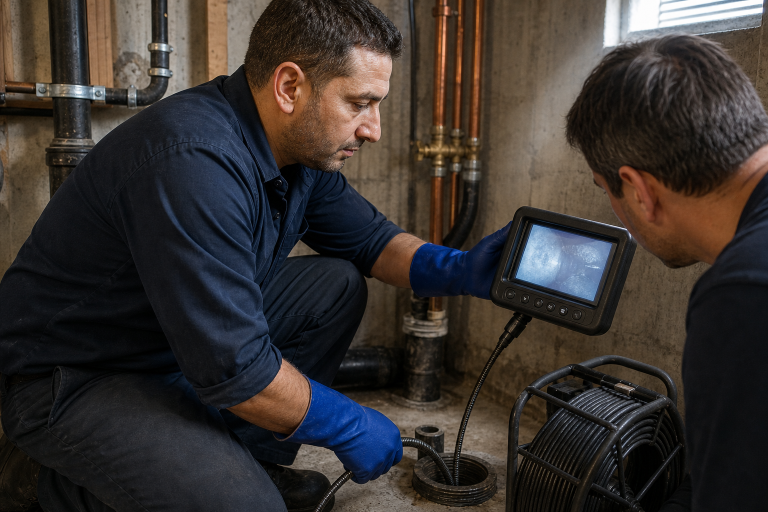
A re-pipe replaces the supply side: the pressurized pipes that carry drinking water to your taps. Drains and vents are a different system, and in older homes they are often cast iron stacks feeding a clay or cast iron line to the street. While the walls are open, a drain camera inspection lets you watch the screen with us and see that side too. And if you have been pouring drain cleaner into a slow sink, the lye has likely been eating the rubber gaskets in the trap, turning a small clog into a trap replacement.
How does a whole-house re-pipe actually go in an occupied home?
A whole-house re-pipe in an occupied home follows the same sequence whether the pipe is PEX-A, copper or a hybrid. We stage the work so the house has water back at the end of the day wherever the layout allows. Permit requirements vary by municipality, so we confirm them with the local building department and work to the Ontario Building Code.
We count fixtures, confirm municipal water or well, and find routes through closets, chases and basements that avoid opening finished walls.
Acidity and hardness decide how much copper belongs in the house and whether treatment should go in first.
The supply is shut off upstream at the street service or the well system first, then the old main valve comes out and a reliable new one goes in.
PEX-A goes through the cavities, copper goes where it stays exposed, and a manifold goes in if you chose home-run distribution.
Kohler, Moen and Delta faucets and American Standard or Toto toilets get fresh stops and supplies instead of reusing tired ones.
The new system is tested and inspected where required before a single access opening gets patched.
An electrician confirms bonding, and we leave access holes square and clean so patching goes quickly.
Step five is where small problems show up. A toilet that refills slowly usually needs only a fill valve, but left alone it can lift the tank seal and become a tank-to-bowl gasket job. We would rather catch that while the water is already off. See our whole-house re-piping service for what a walkthrough covers.
Does a Simcoe County winter or a private well change the pipe choice?
A Simcoe County winter and a private well both push the choice toward PEX-A, with protection where it is exposed. Long freeze seasons test every water line in an exterior wall, and century farmhouses on fieldstone foundations have plenty of those. The kind of basement where your breath fogs in February is where pipe choice gets decided.
PEX-A usually stretches before it splits when water freezes inside, while copper tends to crack open along the pipe. The fittings and valves on a PEX system can still fail, so the plan is always to keep lines warm: route them inside the insulation, avoid cold exterior walls where possible and heat-trace the spots you cannot avoid. Our frozen and burst pipe repair page covers what to do when a line has already let go.
Wells around Midhurst, Cookstown, Angus and Alliston vary a lot. Acidic water attacks copper, and hard water scales every pipe and appliance it touches. Public Health Ontario offers private well water testing, and pairing the re-pipe with the right water softener or well treatment protects the new lines and your water heater.
For seasonal owners with a cottage north toward Orillia or a lakeside property in Innisfil, we design the re-pipe to drain down cleanly for winter and keep PEX out of sunlit porches and away from rodent runs. A Moen Flo smart water monitor on the new main can watch for leaks and shut the water off while nobody is there. That combination protects a house that sits empty for months.
PEX-A tolerates freezing better than copper but is not freeze-proof, so routing and heat still matter. Acidic well water favors PEX, and a water test should come before the pipe decision. Seasonal properties need a drain-down design and leak monitoring such as Moen Flo.
When should you choose PEX, copper or a hybrid re-pipe?
The right re-pipe material depends on the house, the water and how the building is used. For a landlord with a converted duplex, the homeowner in a newer Alcona subdivision, and the farmhouse buyer near Painswick or Lefroy, the answer below changes.
- Choose full PEX-A for a finished century home with plaster walls, a farmhouse on acidic well water, or any house where fewer wall openings is the priority.
- Choose full copper for an unfinished basement, a shop, a small office or a restaurant where pipe stays exposed, gets bumped and sits near heat.
- Choose the hybrid for most occupied older homes: PEX-A in the walls, copper at the main entry, the water heater and exposed runs.
- Choose PEX-A with protection for cottages and seasonal properties: sleeved or shielded where rodents travel, kept out of daylight and designed to drain down.
- Hold off on either until the water is tested if you are on a private well, because the result may change how much copper belongs in the house.
Our Verdict: which re-pipe should you choose?
For a PEX vs copper repipe Barrie older home whole house project, our verdict is the hybrid: Uponor AquaPEX with expansion fittings through the walls, and copper (often Viega ProPress) at the main, the mechanical room and anywhere pipe stays exposed. It saves plaster, handles freezing better, and puts metal exactly where heat, daylight and rodents live.
If you are a rural owner in Angus or Cookstown with acidic well water, lean further toward PEX-A and treat the water. If you run a restaurant or shop with exposed ceilings, copper is worth it. If you own a seasonal cottage, PEX-A with a drain-down design and a Moen Flo on the main is the setup we would put in our own place.
Full copper everywhere is not wrong. It just costs more wall and more money in most century homes than the result justifies.
Our take after years of re-piping Simcoe County homes
Homeowners overweigh the pipe and underweigh the plan. On any PEX vs copper repipe Barrie older home whole house job, the things that decide whether you love it in ten years are the main shutoff, the routing through cold walls, the transitions at the water heater and the bonding check. The pipe material is one line on that list.
What actually matters is access and water. How much plaster can we reach from the basement and closets, and what does your water do to metal? Answer those two and the material mostly picks itself.
The one thing we would tell a friend: do not start by swapping the old main valve yourself. Get a working shutoff installed properly first. Everything else can wait a week.
Frequently asked questions about PEX and copper re-pipes
Is PEX safe for drinking water in an older home?
PEX tubing for drinking water is safe when it carries a CSA certification mark for potable water and is installed to the manufacturer’s instructions. We use PEX-A such as Uponor AquaPEX with its matching expansion fittings. On a private well, test the water first so any treatment matches the house.
Will PEX freeze and burst in a Simcoe County winter?
PEX pipe in a Simcoe County winter can still freeze, but PEX-A tubing usually stretches before it splits, where copper tends to crack open along the pipe. Fittings and valves remain weak points, so lines in exterior walls, crawlspaces and cottages still need heat, insulation or a drain-down plan.
Do I need an electrician after replacing copper with PEX?
Replacing metal water pipe with PEX can remove the path your electrical system used for bonding, so yes, have a licensed electrical contractor check it. In Ontario the Electrical Safety Authority (ESA) oversees electrical work, and we flag bonding at the start of every re-pipe so it is not an afterthought.
How do you price a PEX or copper whole-house re-pipe?
Allain Plumbing prices every PEX or copper whole-house re-pipe after walking the house, because fixture count, number of floors, wall access and the water source change the job more than the pipe does. PEX-A usually comes in lower than full copper on material and labor, and the hybrid lands in between. Contact us for an upfront written quote.
Sources
- Ontario Building Code (O. Reg. 332/12), which governs plumbing and potable water systems in Ontario: Government of Ontario, e-Laws
- Electrical bonding and grounding oversight when water piping changes: Electrical Safety Authority (ESA)
- Private well water testing for Ontario homeowners: Public Health Ontario
- PEX-A tubing, expansion fittings and installation instructions: Uponor
Allain Plumbing
Book a PEX or Copper Re-Pipe Walkthrough for Your Older Home →
🎧 Listen to article
- A Customer Asked: “Can We Add a Bathroom to Our Midhurst Home Without Tearing Up the Whole Main Floor?”
- Inside a Drain Camera Inspection in Barrie’s West End: What a Typical Aging-Line Job Looks Like, Start to Fini
- Kohler vs American Standard Toilet: Which Brand Holds Up Better in a High-Use Bradford Family Home
- Rinnai vs Navien Tankless Water Heater: Which Brand We See Perform Better in Simcoe County Homes
- Inside a Burst Pipe Emergency Call in Barrie’s Painswick Neighbourhood: What a Typical Winter Job Looks Like,
- A Customer Asked: “Can We Add a Bathroom to Our Midhurst Home Without Tearing Up the Whole Main Floor?”
- Inside a Drain Camera Inspection in Barrie’s West End: What a Typical Aging-Line Job Looks Like, Start to Fini
- Kohler vs American Standard Toilet: Which Brand Holds Up Better in a High-Use Bradford Family Home
- Rinnai vs Navien Tankless Water Heater: Which Brand We See Perform Better in Simcoe County Homes
- Inside a Burst Pipe Emergency Call in Barrie’s Painswick Neighbourhood: What a Typical Winter Job Looks Like,